ASHWORTH

Financial Planning

  • Home
  • About Us
    • Stephen Buckle
    • Rachel Buckle
    • Wendy Bloomfield
    • Becky Evans
  • About You
    • People planning for retirement
    • People who have already retired
    • Business owners
  • What We Do
    • Financial Planning
    • How We Work
    • Investment Management
    • Solicitors & Accountants
  • Why choose us?
  • Our charity partners
  • Case studies
  • News
  • Contact
    • FAQs
  • Client Portal

Jan 07 2025

3 important variables that could affect your sustainable pension withdrawal rate

Retirement is an exciting milestone, with more free time to dedicate to the things you enjoy. Yet, it can also be a daunting time, especially when it comes to managing your finances.

Flexi-access drawdown is a popular way to access your pension savings as it provides flexibility and means you’re in control of your income. However, it also means you’re responsible for ensuring you don’t run out of money.

With the pressure of managing pension withdrawals, it’s perhaps unsurprising that a study in IFA Magazine found that almost half of retirees are worried about spending too much too soon.

Indeed, statistics from the Financial Conduct Authority indicate some retirees could be withdrawing money from their pension at an unsustainable rate.

For example, more than 30% of people accessing a pension with a value between £100,000 and £249,000 in 2023/24, withdrew at least 8% of their pension. Some of these people may have other pensions or assets they could use to fund retirement, but others could find they face a shortfall in the future because they’re accessing their pension at an unsustainable rate.

One of the challenges of managing pension withdrawals is that some factors are outside of your control.

The known unknowns of retirement

When you’re planning your retirement income, you’re likely to need to consider known unknown factors – you know they will affect your retirement plan in some way, but accurately predicting exactly how they’ll affect you at the start of retirement isn’t possible. 

The list of known unknowns might be lengthy and some won’t affect all retirees. However, there are three key variables that most retirees could benefit from considering when calculating their sustainable pension withdrawal rate.

1. Life expectancy

    If you knew how long your pension needed to provide an income, you could simply break it down into even blocks and rest assured that you wouldn’t run out.

    In reality, you don’t know how long your pension needs to last. The average life expectancy could provide a useful indicator, but it’s far from certain.

    According to the Office for National Statistics, a 65-year-old man has an average life expectancy of 85. However, he also has a 1 in 4 chance of reaching 92 and around 1 in 10 will celebrate their 96th birthday. For a 65-year-old woman, the average life expectancy is 87, with a 1 in 4 chance of reaching 94 and around 10% will celebrate their 98th birthday.

    So, if you based pension withdrawals on the average life expectancy, there’s a chance that you could outlive your pension by a decade or more.

    As a result, erring on the side of caution when calculating how long you’ll spend in retirement could be useful. A retirement plan could help you balance long-term financial security with enjoying your early years of retirement.

    2. Inflation

    The income you’ll need to maintain your lifestyle during retirement is unlikely to be static. Instead, inflation will usually mean your income will need to increase each year.

    The Bank of England (BoE) has an annual inflation target of 2%. While this might seem like it’ll have little effect on your income needs, over decades it could add up. In addition, the recent period of high inflation has highlighted that the cost of goods and services can rise at a faster pace.

    According to the BoE, if you retired in 2018 with an annual income of £40,000, just five years later your income will need to have increased to almost £50,000 just to provide you with the same spending power.

    Failing to consider the effect inflation might have on your needs and wealth could derail your plans.

    Indeed, an IFA Magazine report suggests the number of retirees searching for a job increased by 16% in 2024 when compared to a year earlier due to rising living costs.

    3. Investment performance

    One of the potential benefits of choosing flexi-access drawdown is that your pension will usually remain invested. This provides an opportunity for your pension to generate investment returns.

    However, it’s not always straightforward. The performance of your investments could have a direct effect on the sustainable withdrawal rate.

    For instance, during a downturn, you’d need to sell a greater proportion of your pension investments to achieve the same income. This could mean you deplete your pension quicker than expected and leave a potential shortfall in the future.

    When weighing up the effect of investment performance, you might need to consider questions like:

    • What are my expected investment returns?
    • What is an appropriate level of risk for me in retirement?
    • How should I manage pension withdrawals if the value of my pension falls?

    Regular reviews could help you assess investment performance and make adjustments to your retirement income when appropriate. 

    Other unexpected factors could affect your retirement finances too

    It’s not just these three known unknowns of retirement that could affect your finances, either. Other variables outside of your control might affect your income needs too, from emergency repairs to your home to care costs later in life.

    When creating a retirement plan, adding a buffer and carrying out regular reviews could help you manage your finances and feel confident about the future.

    Get in touch to talk about creating a sustainable retirement income

    Contact us to talk about your retirement plans and how you might manage financial variables, including known unknowns. A retirement plan could give you confidence in your finances and mean you can focus on enjoying the next chapter of your life.

    Please note: This blog is for general information only and does not constitute financial advice, which should be based on your individual circumstances. The information is aimed at retail clients only.

    A pension is a long-term investment not normally accessible until 55 (57 from April 2028). The fund value may fluctuate and can go down, which would have an impact on the level of pension benefits available. Past performance is not a reliable indicator of future performance.

    The tax implications of pension withdrawals will be based on your individual circumstances. Thresholds, percentage rates, and tax legislation may change in subsequent Finance Acts. 
    Written by SteveB · Categorized: Uncategorised

    Jan 07 2025

    How to pass on assets to vulnerable family members

    When creating an estate plan, there might be people you want to pass wealth to but they’re not in a position to manage their finances. Using a trust could provide a way to leave a vulnerable loved one assets and feel confident they’ll be effectively managed.

    Trusts aren’t used as commonly as other ways to pass on wealth, such as gifting or leaving an inheritance directly. In fact, according to government figures, there were only around 733,000 trusts and estates registered on the Trust Registration Service as of March 2024. Yet, in some circumstances, a trust could present a valuable option.

    There are many reasons why you might consider someone vulnerable or not want to pass on assets directly to them. You might consider using a trust if you want to pass on wealth to:

    • A child
    • A person at risk of financial abuse
    • Someone who has made poor financial decisions in the past
    • An adult who has a disability that affects their ability to manage finances.

    A trust may allow you to improve the financial security of loved ones without them being responsible for managing assets.

    A trust means someone you choose can manage assets on behalf of beneficiaries

    A trust is a legal arrangement that you (the settlor) set up where assets are managed by a person or people (the trustee) for the benefit of one or multiple other people (the beneficiary).

    So, while the beneficiary may benefit from the assets, it’s the trustee who will manage them. As the settlor, you can set out how and when you want the assets, and any income they generate, to be used.

    For instance, if you want to pass on wealth to your grandchild, you might name their parents as trustees. You could state money may be withdrawn from the trust to cover educational costs and, once the child turns 25, they can withdraw and take control of the remaining assets.

    Or, if you want to provide for a disabled adult, you might create a trust that states the trustee is to provide the beneficiary with a regular income for the rest of their life.

    Crucially, as the settlor, you can set the terms of the trust so that it suits your goals.

    You should note that there are several different types of trust and, once set up, it can be difficult or impossible to reverse the decisions you’ve made. So, seeking professional legal advice if you think a trust could be an option for you may be valuable.

    3 important questions to consider if you’re thinking of using a trust

    Before you set up a trust, it’s important to consider if it’s the right option for you. Here are three essential questions that may help you start to weigh up the pros and cons.

    1. Who would act as the trustee?

      Choosing someone to act as a trustee can be difficult, so you might want to consider who you’d ask.

      You want a person you can trust to act in line with your wishes and in the best interest of the beneficiaries. However, you may also want to think about the skills they have – are they comfortable handling finances? Are they organised enough to manage the trust effectively?

      You can choose more than one trustee, and set out whether you’d like them to make decisions together. You may also choose a professional to act as a trustee, such as a solicitor or financial planner, who would charge a fee for their services.

      2. What would be the aim of the trust?

      Thinking about the reasons for creating a trust is essential, as it might affect the type of trust that’s right for you and the terms you set out.

      For example, a trust that’s simply holding assets until a certain date could be very different from one you want to use to preserve family wealth for future generations.

      In some cases, you might find that an alternative option is better suited to your needs.

      Let’s say you want to set money aside for your grandchild to access when they turn 18. A Junior ISA (JISA) allows you to save or invest up to £9,000 in 2024/25 tax-efficiently on behalf of a child. The money held in a JISA is locked away until they reach adulthood. So, it might be more appropriate and avoid the complexity a trust may add.

      3. How much control would you give the trustee?

      If you have a clearly defined idea about how you want the trust to operate, you might choose to set out exactly when the assets can be used. Alternatively, you may give more control to your trustee and allow them to use their judgment.

      There isn’t a right or wrong answer, so focusing on what’s important to you is key.

      When setting out terms or restrictions, you may want to spend some time weighing up different scenarios and the effect they might have.

      For instance, if you want the trust to provide a defined income, you might want to consider:

      • How the trustee should adjust the income for inflation
      • Whether they can withdraw a lump sum in certain circumstances
      • If there is a point you want the beneficiaries to take control of the assets.

      Rigid restrictions could have unintended consequences.

      Let’s say your loved one has an opportunity to purchase a property. Withdrawing a lump sum to act as a deposit could mean their day-to-day costs fall and provide greater security when compared to renting, but restrictions might mean this isn’t possible. Or if they face a medical emergency, accessing the wealth held in a trust could enable them to receive treatment quicker or provide more options.

      Contact us to talk about your estate plan

      A trust is often just a small part of an effective estate plan. If you’d like to discuss how you might pass on wealth to loved ones in a way that aligns with your goals and considers your wider financial plan, please get in touch.

      Please note: This blog is for general information only and does not constitute financial advice, which should be based on your individual circumstances. The information is aimed at retail clients only.

      The value of your investments (and any income from them) can go down as well as up and you may not get back the full amount you invested. Past performance is not a reliable indicator of future performance.

      The Financial Conduct Authority does not regulate estate planning, tax planning, or trusts.

      Written by SteveB · Categorized: Uncategorised

      Dec 10 2024

      Research: The perils of chasing stock market “winners”

      Following the stocks and shares that have experienced impressive returns can seem like fun and a way to make the most out of your investments.

      Yet, a study indicates that following the crowd and investing in companies that are being hyped in the press or among investors could mean you miss out on growth opportunities from other sources.

      Top stocks rarely perform well for two consecutive years

      Research carried out by Schroders looked at the top 10 performing stocks on the US stock market each year.

      Interestingly, in 12 of the past 18 years, not a single stock that was in the top 10 also made it into the top 10 in the following year. Of the other six years, in five of them, only a single company managed to maintain its strong position.

      Even staying in the top 100 is rare – an average of 15 companies each year managed to be in the top 100 for two consecutive years. The odds of making it back onto the list in a couple of years are similarly low.

      You might be surprised to learn that companies that performed well are more likely to be among the worst-performing stocks a year later.

      The research noted that a similar trend can be seen in other markets. In the UK, 11 out of 18 years saw the average top 10 performers move to the bottom half of the performance distribution the next year.

      So, if you’ve been hearing about how well a particular stock has been performing, automatically investing in it might not be the right thing to do. It could expose you to more investment volatility than is appropriate for you.

      There’s also a risk that companies that are hyped might be overvalued.

      The Magnificent Seven is a group of influential technology companies – Apple, Microsoft, Nvidia, Alphabet, Amazon, Meta Platforms, and Tesla – on the US stock market that has made impressive gains over the last year. However, Schroders found collectively they are twice as expensive as the rest of the market in terms of a multiple of the next 12 months of earnings.

      Some companies will deliver these expectations, but others won’t, and identifying which ones will meet targets can be difficult.

      3 investing lessons you can learn from the volatility of the top stocks

      1. Don’t fall for hype

        It can be tempting to invest in a company that’s experienced impressive growth recently. But the Schroders study highlights how these companies can experience a fall just as much as others, and perhaps more severely.

        Chasing the “hot” stocks could result in higher costs and lower returns than if you opted for investments that were consistently delivering average returns.

        That’s not to say you should avoid investing in popular stocks. Indeed, many investment funds will hold investments in the Magnificent Seven. What’s important is assessing if it’s the right option for you and focusing on long-term gains, rather than short-term rises.

        2. Accept the investment market can be volatile

        As the research highlights, volatility is part of investing.

        As an investor, accepting this can be difficult – you understandably don’t want to see the value of your investments fall. Yet, for most investors, sticking to their long-term plan, even when markets dip, makes financial sense if you take a long-term view.

        Historically, markets have delivered growth when you look at performance over a longer time frame, including after sharp drops like those experienced during the pandemic in 2020.

        While returns cannot be guaranteed and past performance is not a reliable indicator of future performance, history suggests holding investments and waiting out volatility may be the right course of action for you.

        Volatility is why it’s often recommended that you invest with a minimum time frame of five years. This provides time for the ups and downs of the market to smooth out and, hopefully, deliver investment returns.

        3. Ensure your investments are diversified

        If you invested in just one company that was in the top 10 performing stocks, the research suggests the value could fall within the next year. However, if you spread your investment across multiple stocks, you could reduce the risk of this happening.

        Diversifying your investments means investing in a range of assets, sectors, and geographical locations. When one area of your investments experiences a drop, a rise in another could offset this.

        This is how investment funds work. A fund would pool your money with that of other investors and then invest in a wide range of assets in line with the fund’s risk profile. So, if you want to diversify your investments, a fund could be a good solution for you.

        Invest in a way that reflects your goals and circumstances

        If you have any questions about how to invest in a way that’s appropriate for your goals and circumstances, we’re here to help. We can offer ongoing support to ensure your investments continue to reflect your needs. Please contact us to speak to one of our team.

        Please note: This blog is for general information only and does not constitute advice. The information is aimed at retail clients only.

        The value of your investments (and any income from them) can go down as well as up and you may not get back the full amount you invested. Past performance is not a reliable indicator of future performance.

        Investments should be considered over the longer term and should fit in with your overall attitude to risk and financial circumstances.

        Written by SteveB · Categorized: Uncategorised

        Dec 10 2024

        5 practical ways you could keep your child’s retirement on track

        Longer lives and financial pressure mean many people believe that retiring in their 60s will become a thing of the past. So, if you want to ensure your child or grandchild can enjoy financial security later in life, how could you help them? Read on to find out.

        Two-thirds of Brits believe retiring in your 60s will become a trend of the past

        Most people planning for their retirement today, probably imagine themselves stepping away from work in their 60s. Indeed, according to the Office for National Statistics (ONS), in 2021 the average age of retirement for both men and women was 66.

        Yet, that milestone could be decades later for younger generations.

        A survey carried out by Canada Life found that 69% believe that retiring in your 60s will become a thing of the past. One of the biggest reasons for this is the expectation that we’ll live longer than previous generations. In fact, the median ideal age was found to be 90.

        ONS figures highlight how growing life expectancy will affect the population of the UK. Between 2023 and 2050 the number of people aged 65 and above is expected to grow by just under 40%. Similarly, there is expected to be a 200% rise in the number of people who celebrate their 100th birthday during the same period.

        Longer lives can present challenges, including the need to fund more years in retirement. So, it’s not surprising that two-thirds of people believe working for longer is the solution. Yet, that may not align with the goals or lifestyle aspirations of younger people.

        If you’re worried about how your children or grandchildren are preparing for their retirement, even if it’s decades away, there may be some steps you can take.

        How to help younger generations prepare for retirement

        1. Encourage them to engage with their pension early

          Retirement can seem like a milestone that’s too far away to concern yourself with when you’re starting your career. However, engaging with their pension early could mean loved ones have far more saved for retirement.

          Pension contributions are typically invested so they have an opportunity to grow. As the money cannot be withdrawn, the returns are usually invested and may generate additional returns. This compounding effect means that small contributions at the start of a career could grow significantly.

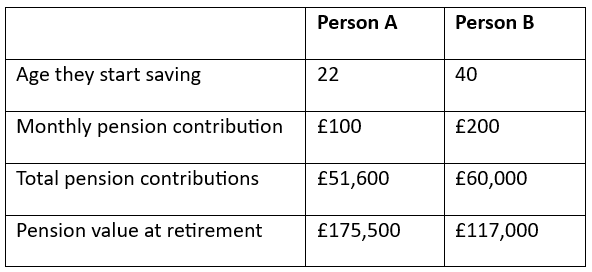
          Assuming an annual investment return rate of 5% before fees are considered and a retirement age of 65, the below table highlights how compounding could affect the retirement savings of two workers.

          Source: Legal & General

          As you can see, person B contributes more than £8,000 extra to their pension, but as they’ve missed out on 18 years of compounding, the value of their pension is almost £60,000 lower when they retire.

          So, if your child or grandchild has paused their pension contributions or opted out of their workplace scheme, encouraging them to reconsider their decision could put them on track for a retirement that offers greater financial security.

          2. Contribute to their pension on their behalf

            If you’d like to lend a helping hand, you could make contributions to your loved one’s pension. Their pension would benefit from an immediate boost and the potential investment returns might mean your initial gifts grow over the long term. 

            You may want to speak to your family member about the contributions that are already going into their pension, including those made by their employer, to avoid exceeding the Annual Allowance, which could trigger a tax charge.

            In the 2024/25 tax year, the Annual Allowance is £60,000 for most people and pension contributions of up to 100% of the pension holder’s annual salary can benefit from tax relief. If the pension holder is a high earner or has already flexibly accessed their pension, their Annual Allowance may be lower.

            Unused Annual Allowance may be carried forward from the previous three tax years.

            Remember, money that is contributed to a pension isn’t accessible until the pension holder is 55 (rising to 57 in 2028). As a result, you might want to assess your own financial security and the effect a gift could have on it before you contribute to a pension on behalf of a family member.

            3. Lend financial support to help them reach other goals

            Financial pressures might mean your loved one is considering halting pension contributions. So, speaking to them about other challenges they might be facing could highlight where your support may allow them the financial security to start saving for retirement.

            For example, younger family members may be struggling to pay rent and save a deposit to get on the property ladder. A gift from you to help them reach the milestone of homeownership might mean they’re in a better position to start regularly contributing to a pension.

            Alternatively, day-to-day financial pressures may mean your child or grandchild is hesitant to place money into a pension that they wouldn’t be able to access until they reached retirement age. In this case, regular financial support that could be used to cover everyday costs might give them the confidence to place money in a pension.

            Again, assessing your financial plan and the implications of handing over regular gifts could help you understand the effect it might have on your wealth in both the short and long term.

            4. Consider your legacy now

            As part of your legacy, your wealth could be used to help children or grandchildren secure financial freedom in retirement. Reviewing your estate plan now could highlight ways you could support this goal, including through gifting assets during your lifetime or leaving wealth after you’ve passed away.

            While creating an estate plan, it’s important to keep in mind that things may change. For instance, if you need to pay for care later in life, the inheritance you leave for loved ones could be less than you expect.

            5. Refer them to your financial adviser

            While loved ones are accumulating wealth, they might think they wouldn’t benefit from working with a financial planner. Yet, it’s never too soon to start thinking about retirement or other long-term goals. In fact, working with a professional before they step back from work could present an opportunity to grow their wealth further and create a more comfortable retirement.

            So, if your children or grandchildren aren’t working with a financial planner, introducing them to yours could help get their finances on track.

            Get in touch to discuss how you could support loved ones

            If you’d like to talk about your options for lending financial support to loved ones, including helping them prepare for retirement, please get in touch. We could work with you to help you balance your financial security and retirement goals with the aid you might want to provide family members.

            Please note: This blog is for general information only and does not constitute advice. The information is aimed at retail clients only.

            A pension is a long-term investment not normally accessible until 55 (57 from April 2028). The fund value may fluctuate and can go down, which would have an impact on the level of pension benefits available. Past performance is not a reliable indicator of future performance.

            The tax implications of pension withdrawals will be based on your individual circumstances. Thresholds, percentage rates, and tax legislation may change in subsequent Finance Acts. 

            Written by SteveB · Categorized: Uncategorised

            Dec 10 2024

            The key Autumn Budget takeaways business owners should be aware of

            As a business owner, the Autumn Budget delivered at the end of October 2024 could affect both your business and personal finances. Read on to discover the key changes you need to be aware of.

            2 Budget tax changes that could affect your business’s finances

            The good news is that despite speculation that Corporation Tax could rise, this didn’t materialise.

            Indeed, the Corporate Tax Roadmap sets out the government’s intention to cap the headline rate of Corporation Tax at 25% for the duration of the current parliament. It also states it will maintain the Small Profits Rate and capital allowances.

            However, two key announcements could affect your business’s outgoings.

            The national living wage and minimum wage for young people will both rise in April 2025

            If you have employees who earn the national living wage, your payroll expenses are likely to rise in April 2025.

            From 6 April, the national living wage for employees who are aged 21 and over will increase by 6.7% from £11.44 an hour to £12.21. Younger workers aged under 21 who earn the national minimum wage will also benefit from a pay boost when it rises from £8.60 to £10 an hour.

            Employer National Insurance will rise to 15%

            Potentially having a larger effect on your business finances are the changes the chancellor unveiled to employer National Insurance (NI).

            Effective from 6 April 2025, the employer NI rate will increase by 1.2% from 13.8% to 15%.

            In addition, the threshold at which you will pay NI will fall. Under the current rules, employers pay NI on earnings above £9,100 a year. For the 2025/26 tax year, this threshold will fall to £5,000.

            So, not only may your business be paying a higher rate of NI, but it will also be paying NI on a larger proportion of employees’ earnings.

            On a more positive note, in 2024/25, employers with an NI bill of £100,000 or less may benefit from the Employment Allowance, which provides a £5,000 discount. In 2025/26, the threshold will be removed, so all eligible employers will now benefit, and the discount will rise to £10,500.

            As a business owner, there may be steps you can take to reduce the effect the changes will have on your firm’s finances. For example, offering your employees a salary sacrifice scheme could be a useful way to reduce your NI bill and offer a perk that may benefit employees too.

            If you’d like to discuss the steps your business could take to improve tax efficiency, please get in touch.

            2 Budget announcements that could affect your finances when you leave the business

            Moving on from your business might not be part of your plans now, but it may still be important to consider your tax liability if or when you exit later. Understanding your tax position could help you create a tax-efficient exit strategy that suits your needs.

            Some Budget announcements could affect your plans, and you may want to review them as a result.

            The main rates of Capital Gains Tax have increased

            Changes to the main rates of Capital Gains Tax (CGT) were effective immediately after the Budget and affect asset disposals made on or after 30 October 2024.

            CGT is a type of tax you pay when you make a profit disposing of certain assets, including when you sell some business assets.

            The basic rate of CGT has increased from 10% to 18% and the higher rate went from 20% to 24%.

            The government revealed it would maintain the Business Assets Disposal Relief (BADR) – formerly known as “Entrepreneurs’ Relief” – at £1 million. However, the BADR rate of CGT will rise from 10% to 14% on 6 April 2025 and to 18% on 6 April 2026.

            As a result, the tax bill you face when selling your business could be higher than you expect.

            Changes to reliefs could affect your estate’s Inheritance Tax liability

            If you plan to leave your business to a loved one when you pass away, changes to Inheritance Tax (IHT) reliefs could affect your estate’s tax liability.

            After 6 April 2026, Agricultural Property Relief will be capped at £1 million and assets that exceed this threshold could be liable for IHT with a 50% relief applied. Business Property Relief will also fall from 100% to 50% in all circumstances for shares designated as “not listed” on the markets of a recognised stock exchange.

            There are often steps you can take to reduce a potential IHT bill, but you usually need to be proactive. If you’d like to discuss how you could pass on your business and minimise a potential IHT bill, please get in touch.

            Get in touch to understand how the Budget may affect you

            If you’d like to talk about how the Budget could affect your finances and those of your business, please get in touch. We can work with you to understand what announcements mean for you and the steps you might take to reduce the effect changes could have.

            Please note: This blog is for general information only and does not constitute advice. The information is aimed at retail clients only.

            Please do not act based on anything you might read in this article. All contents are based on our understanding of HMRC legislation, which is subject to change.

            The Financial Conduct Authority does not regulate tax planning or Inheritance Tax planning.

            Written by SteveB · Categorized: Uncategorised

            Dec 10 2024

            Investment market update: November 2024

            On 5 November 2024, US citizens voted for their next president, and the election had a knock-on effect on investment markets and business prospects around the world.

            Republican Party nominee Donald Trump will serve a second term as president of the US. Trump has previously spoken about imposing harsh import tariffs, including a tariff of up to 60% on goods imported from China or a blanket 20% tariff on every US trading partner.

            So, it’s unsurprising that the results of the election are being felt across the world. Indeed, Bloomberg’s Commodity Index suggests the prices of industrial metals and commodities have already slumped due to concerns about a “tit-for-tat global trade war”.

            UK

            The Labour government delivered its Autumn Budget at the end of October, and the repercussions were still being felt at the start of November.

            Credit ratings agency Moody’s said the Budget would be an “additional challenge” for public finances as the announcements would do little to boost UK economic growth. It noted there was also a limited buffer if the UK faced a financial shock.

            Similarly, S&P stated that public finances would be “constrained” but added that public investment plans could create a more business-friendly environment.

            The FTSE 100 dropped to a three-month low on 8 November. This was partly due to retailers suffering losses as it became clear how higher rates of employer National Insurance contributions announced in the Budget could affect profitability. Marks & Spencer saw a 4.5% drop, and Tesco (2.9%), JD Sports (2.7%), and Sainsbury’s (2.5%) all suffered losses too.

            On the same day, housebuilder Vistry issued its second profit warning in as many months, after it said cost overruns on building projects were worse than previously thought. This led to its share price tumbling almost 20%.

            The headline economic figures released in November indicate the UK is stagnating.

            According to the Office for National Statistics (ONS), GDP per head fell 0.1% in the third quarter of 2024 in real terms – the measure is used as an indicator of the country’s living standards.

            In addition, ONS figures show inflation increased to 2.3% in the 12 months to October 2024. The rise could mean the Bank of England delays plans to reduce its base interest rate.

            Readings from Purchasing Managers’ Indices (PMI) suggest business activity is weakening. However, some businesses may have paused investments and key decisions until the Budget was delivered, so activity could pick up in the final months of 2024.

            In October, the British manufacturing PMI had a reading of 49.9 – slightly below the 50 mark that indicates growth. While still in growth territory, the service sector also slowed when compared to a month earlier with a reading of 52.

            There’s already speculation about what a Trump presidency will mean for the UK.

            The National Institute of Economic and Social Research said the protectionist measures planned by Trump could halve the UK’s economic growth in 2025 and 2026.

            Yet, there may be some good news for investors. On the back of Trump’s victory, the pound weakened on 6 November. This led to the FTSE 100 jumping 1.3% as share prices lifted for multinational firms. For example, equipment rental company Ashtead, which would benefit from a strong US economy, saw a 6.6% boost.

            Europe

            While PMI readings suggest the eurozone economy is improving, it has recorded production falling for 19 consecutive months as of October 2024. The bloc’s two largest economies are playing a role in dragging down the figure as both France and Germany are affected by exports falling and weak demand.

            Trump’s victory also had repercussions across Europe.

            Shares in European renewable energy companies slid on 6 November as Trump has previously spoken about plans to boost US oil production. Danish wind turbine maker Vestas Wind Systems fell 8% and German solar energy producer SMA Solar Technology was down 10.4%.

            Similarly, the threat of tariffs from the US hit German carmakers on 6 November. Porsche was the biggest faller on the German index DAX after it tumbled 7.4%, followed by BMW, Mercedes-Benz, and Volkswagen.

            US

            Just days before the US election, official figures showed that just 12,000 new jobs were added to the US economy in October. The figure is far below the 113,000 that economists expected and the 254,000 recorded in September. The low number may be due to businesses holding back decisions until election uncertainty passed, but it may have dealt a blow to the Democratic Party.

            On 6 November, the day after the US election, the US dollar had its best day in four years as it climbed 1.5% against a basket of other countries.

            In pre-trading on 6 November, shares in Trump Media & Technology were up almost 36%. Similarly, Elon Musk, who is a supporter of Trump, saw his business Tesla receive a 13% boost in premarket trading.

            When the US stock market opened, it reached an all-time high. The S&P 500 index was up 1.9% and the Dow Jones benefited from a 3% bump as investors bet on Trump’s policies stimulating economic growth.

            US company Disney also saw a boost on 14 November and share prices hit a six-month high. The value of the business increased by almost 10% thanks to the success of films Inside Out 2 and Deadpool & Wolverine. 

            Inflation in the US continues to be above the 2% target. In the 12 months to October 2024, inflation was 2.6%, up from the 2.4% recorded in September.

            Asia

            China responded to the threat of Trump tariffs saying there would be no winners if a trade war began. Instead, ambassador Xie Feng said the US and China should focus on mutually beneficial cooperation to achieve many “great and good things”.

            It was good news for China’s economy in October, with an official PMI showing factory activity returned to growth, ending five consecutive months of contraction. On 1 November, the news led to Hang Seng in Hong Kong adding 1% and the Shanghai Composite index rising by 0.4%.

            Perhaps surprisingly, Japan’s Nikkei index gained as it waited for the outcome of the US general election on 5 November. The index rose 1.9% as a weaker yen boosted Japanese exporters’ overseas earnings.

            Please note: This blog is for general information only and does not constitute advice. The information is aimed at retail clients only.

            The value of your investments (and any income from them) can go down as well as up and you may not get back the full amount you invested. Past performance is not a reliable indicator of future performance.

            Investments should be considered over the longer term and should fit in with your overall attitude to risk and financial circumstances.

            Written by SteveB · Categorized: Uncategorised

            • « Previous Page
            • 1
            • 2
            • 3
            • Next Page »
            Ashworth Financial Planning Ltd is authorised and regulated by the Financial Conduct Authority. You can find Ashworth Financial Planning Ltd on the FCA register by clicking here. Registered in England & Wales. Company number: 08401597. Registered Office: Unit 1-1A, Park Lane Business Centre Park Lane, Langham, Colchester, Essex, England, CO4 5WR.

            © 2026 · Ashworth FP · Legal · Web Design by D*Haus Agency