ASHWORTH

Financial Planning

  • Home
  • About Us
    • Stephen Buckle
    • Rachel Buckle
    • Wendy Bloomfield
    • Becky Evans
  • About You
    • People planning for retirement
    • People who have already retired
    • Business owners
  • What We Do
    • Financial Planning
    • How We Work
    • Investment Management
    • Solicitors & Accountants
  • Why choose us?
  • Case studies
  • News
  • Contact
  • Client Portal

Jun 08 2022

Do you have “green guilt”? Here are 8 simple ways to make your lifestyle more environmentally friendly

More people than ever are embracing lifestyle changes to reduce the negative effect they have on the environment. As the effect of our choices becomes more widely known, some feel guilty about the decisions they make.

According to an Aviva survey, 64% of adults in the UK have experienced “green guilt” after carrying out environmentally-unfriendly actions.

If you’ve felt guilty about your lifestyle, there are some simple things you can do to have a more positive effect, including these eight steps.

1. Reduce how much plastic you buy at the supermarket

The effect of plastic pollution on wildlife and ecosystems is huge. So, it’s not surprising that using single-use plastic products is one of the most common things to cause green guilt.

The use of plastic shopping bags has fallen drastically since the charge was introduced in 2015 – 28% of people feel guilty when they buy one today. Choosing products that use less plastic packaging or purchasing reusable muslin produce bags to cut back further can make your weekly shop more environmentally friendly.

2. Choose paperless bills

If you’ve already set up direct debits and manage your accounts online, switching to paperless contact makes sense. Not only does it reduce waste, but the letters don’t need to travel to reach you.

When using paperless billing, make sure your account details are secure, regularly check that the bills are accurate, and download and save any necessary files.

3. Be mindful of your energy use

With utility bills soaring this year, cutting back on how much energy you use might be something that’s already on your mind.

Simple steps like switching gadgets off at the wall, rather than leaving them on standby, choosing energy-efficient light bulbs, and turning down your thermostat really do add up.

If you have a smart meter, you can easily track how the changes you’re making are affecting your energy use.

If you want to invest in your home and reduce bills in the long term, taking steps to improve its energy efficiency can make sense. From insulating your loft to upgrading windows and doors, these steps could dramatically cut how much energy you need to heat your property.

4. Cut back on using your car for short journeys

Hopping in the car when you need to pick up some milk or to drop the children off at school is convenient, but we know that a short journey can unnecessarily harm the environment.

More than a fifth of Brits said they feel guilty after using the car for a short journey. Committing to walking more will boost your eco-credentials, and there are lots of health benefits too. 

5. Reduce how much meat and fish you eat

There are more options than ever for vegetarians and vegans, and you don’t have to give up meat entirely to have a positive effect on the planet.

Rearing animals is an intensive process that contributes to climate change in several ways, including deforestation and the release of greenhouse gases.

14% of people said they feel guilty about how much meat or fish they eat. Cutting out animal products just a few days a week can really add up. It’s also a chance to explore new dishes.

6. Choose local produce when you can

More people are choosing to support local businesses when they shop. It’s a step that can improve your community and means that items don’t have to travel as far to get to you. So, shopping at local butchers or greengrocers where possible can reduce your carbon footprint.

7. Add flowers to your garden

One simple way to help nature thrive is to make your garden more wildlife-friendly. Adding flowers can support the local ecosystem, from birds to insects, and brighten up your garden.

Adding plants to your outdoor space doesn’t have to be a lot of hard work. There are low maintenance options, such as wildflower seeds you can scatter. Planters are a good choice if you have limited space.  

8. Offset your emissions

If you’re worried about your carbon footprint, offsetting emissions can reduce your impact. You may want to regularly offset your emissions or after one-off events, like going on holiday, as 12% of people said they feel guilty about travelling by aeroplane.

When you offset your emissions, your money will be used to fund projects like reforestation. However, be cautious as some projects may not have the positive effect you hope for, and some scams pose as offsetting projects.

Written by SteveB · Categorized: News

Jun 08 2022

4 surprising things you can learn about finances from Bridgerton

When you think of TV shows that can teach you valuable financial lessons, Bridgerton probably isn’t the first one that comes to mind.

Yet, the historical romance on Netflix has a few things you can learn about money and financial planning. The first season of the hit show racked up more than 625 million viewing hours in the first 28 days it was available on the streaming platform, and the second season was released earlier this year.

Based on the Regency era, London’s ton is brought to life during the busy social season. Children of nobility and gentry of marriageable age are launched into a society filled with balls, social events, and scandalous secrets. The show follows the eight Bridgerton siblings as they search for love.

Documents from Aviva give a fascinating insight into what Regency era London was like and the items that residents of Grosvenor Square, London, where the Bridgertons reside, prized.

Elizabeth Sophia Lawrence insured the contents of her home in 1815 for £2,000 – the equivalent of more than £2 million today. The items insured include jewels, liquor “for private use”, mathematical and musical instruments, and a carriage.

So, against this backdrop, what can modern-day savers learn from Bridgerton?

1. The positive effects of generational planning

The Bridgertons are one of the most powerful families in the ton, partly because of the wealth they hold and have inherited.

Careful generational wealth planning means the siblings have lived a life of luxury without having to work even though their father passed away. The sizeable estate that’s been carefully managed to secure future generations highlights how useful long-term thinking can be if you want to create financial security for children and grandchildren.

While you may not be passing on a Georgian villa, there are steps you can take to secure the future of the next generation. From opening a Junior ISA for the youngest members of your family to setting out an estate plan that may consider things like trusts and Inheritance Tax, you can give them a financial head start.2

2. Plan for the unexpected

Even the best-laid plans can go off course, and it can leave you or your loved ones in a difficult financial position.

Baron Featherington finds himself in debt after his gambling spiralled out of control and he got involved with a dangerous crowd. When he’s murdered for his bad debts, his wife and three daughters are left in a precarious position. There’s no emergency fund for them to draw on, no life insurance to claim, and they were unaware of the debt the baron had accumulated.

It’s a useful reminder about why having a financial safety net is so important. Whether you have accessible savings to use to cover an unexpected bill or financial protection that will provide an income if you’re unable to work, a plan for the unexpected can be invaluable.

3. Get-rich-quick schemes should be a red flag

An investment opportunity that claims it has guaranteed results and will quickly increase your wealth is understandably tempting. But it’s a sure sign of a scam.

When Lord Jack Featherington arrives on the scene of Bridgerton, he’s the talk of the ton. He quickly becomes one of the most eligible bachelors thanks to his supposed fortune from mining gems in America. Throughout the social calendar, he quietly mentions his success to select people and starts to drum up interest in investing in his new venture.

Blinded by the potential returns, eager investors overlook his dubious intentions and don’t delve further into Jack’s past.

While it can be tempting to hand over money when investment opportunities sound too good to pass up, scams are still rife today. Taking your time to research your options and who is offering you an investment opportunity is crucial for spotting red flags.

4. You don’t have to go it alone

The eldest Bridgerton sibling Anthony is head of the household after his father tragically passed away when he was young.

Both the first two seasons explore the pressure he feels to maintain family finances and ensure their reputation remains positive in the competitive social scene. He brushes off offers of help and advice, instead choosing to take on all the responsibilities alone.

It can be tempting to do the same. While taking control of everything can seem like a good idea, it can lead to you feeling overwhelmed. It can also mean you miss out on valuable guidance or advice. It may mean you miss out on opportunities or that you simply can’t enjoy your successes because you’re already focused on the next challenge.

If you want support to create a financial plan, we can help. We’ll work with you to create a long-term plan that you can have confidence in. Please contact us to arrange a meeting.

Please note: This blog is for general information only and does not constitute advice. The information is aimed at retail clients only.

Written by SteveB · Categorized: News

Jun 08 2022

8 key tax allowances have shrunk by 6% in the last decade

Key tax allowances like the Personal Allowance and Capital Gains Tax (CGT) annual exempt amount can help your money go further. As research shows that overall tax allowances have been cut, it’s more important than ever to understand what allowances make sense for you, and how they can complement your financial plan.

According to calculations by Quilter, over the last decade, eight key tax allowances have fallen by 6% in total. As many of the allowances have failed to grow in line with inflation, in real terms, tax allowances have shrunk at a much sharper pace.

So, which allowances have changed the most in the last 10 years?

The 2 allowances that have increased since 2012/13

Two important allowances have increased in the last decade, which could reduce how much tax you pay.

1. Personal Allowance

The Personal Allowance is the threshold for paying Income Tax. You don’t pay Income Tax on any income that is below the threshold.

It was £7,475 in 2012/13 and has increased to £12,570 for the 2022/23 tax year – a 68% increase.

2. Capital Gains Tax annual exempt amount

If you’re disposing of some assets, such as stocks not held in an ISA, you may be liable for CGT.

The rate of CGT depends on your Income Tax rate, but it can be as high as 20%, or 28% if you’re selling some types of properties. Making use of the annual exempt amount can minimise how much tax you pay when selling assets.

For the 2022/23 tax year, the allowance is £12,300, up from £8,105 10 years ago.

The 6 tax allowances that have fallen in the last decade

1. Pension Annual Allowance

The pension Annual Allowance is the maximum you can contribute to your pension each tax year while still benefiting from tax relief (not including any “carry forward”). In the last decade, the allowance has fallen by 20% to £40,000 in 2022/23.

Some high earners may have an even lower Annual Allowance if they’re affected by the Tapered Annual Allowance. For every £2 you earn over £240,000 (adjusted income), your Annual Allowance falls by £1 to a minimum allowance of £4,000.

2. Pension Lifetime Allowance

The Lifetime Allowance is the total value your pension can be before you may face additional tax charges when you access it. Over the last 10 years, it’s fallen by 28%. So, how much you can save for retirement tax-efficiently has been significantly reduced.

For the 2022/23 tax year, the Lifetime Allowance is £1,073,100.

3. Money Purchase Annual Allowance

The Money Purchase Annual Allowance (MPAA) affects how much you can tax-efficiently add to your pension if you’ve already withdrawn an income from it. So, it may affect people who have flexibly retired or plan to return to work after taking some time off.

The MPAA is now just £4,000. It was £10,000 a decade ago.

4. Nil-rate band for Inheritance Tax

The nil-rate band is the threshold for paying Inheritance Tax (IHT). If the value of all of your assets is below the threshold, you don’t need to pay IHT. If it’s above the threshold your estate may be liable for IHT at a standard rate of 40%.

The nil-rate band hasn’t changed in the last 10 years and is £325,000 for the 2022/23 tax year. While that may seem positive, when you consider inflation and how the value of assets may have grown, particularly property, it’s fallen in real terms.

5. The Inheritance Tax (IHT) annual exemption

Much like the nil-rate band, the annual IHT gifting exemption is the same as it was 10 years ago. So, in real terms, it’s become less valuable.

The annual exemption is £3,000 for the 2022/23 tax year. This is the amount you can gift each tax year without it potentially being considered for IHT purposes, as it’s considered immediately outside of your estate.

6. Dividend Allowance

Dividends are a common way for investors to generate an income from their portfolio or for business owners to pay themselves.

The Dividend Allowance is how much you can receive in dividends before tax is due. When it was introduced in the 2016/17 tax year it was £5,000, but it’s now just £2,000.

How can you get the most out of your tax allowances?

With some allowances now frozen until 2026, understanding which ones make sense for you and will help cut your tax bill is important. We’re here to help you understand how to use the eight allowances above, as well as others that may be appropriate, in your financial plan.

Please contact us to arrange a meeting with our team.

Please note: This article is for information only. Please do not act based on anything you might read in this article. All contents are based on our understanding of HMRC legislation, which is subject to change.

A pension is a long-term investment. The fund value may fluctuate and can go down, which would have an impact on the level of pension benefits available. Your pension income could also be affected by the interest rates at the time you take your benefits. The tax implications of pension withdrawals will be based on your individual circumstances, tax legislation and regulation, which are subject to change in the future.

The Financial Conduct Authority does not regulate estate planning or tax planning.

Written by SteveB · Categorized: News

Jun 08 2022

Total tax collected from exceeding the pension Lifetime Allowance is set to reach almost £1.5 billion annually

Successive cuts to the Lifetime Allowance (LTA) and a freeze means that more people than ever could face an unexpected tax bill when they access their pension.

The LTA is the total amount a person can build up in pension benefits without incurring tax charges. Since it was introduced in the 2006/07 tax year, there have been several cuts to the allowance, and it’s now frozen until 2026.

As a result, more people are being affected by the LTA and the amount the government has collected through the charges has increased.

Could you unexpectedly exceed the LTA?

The LTA covers all your pension benefits, not just your contributions. So, it can be easier than you may think to exceed it unexpectedly.

If you have a defined contribution (DC) pension, your total pension benefits will include your contributions, those made by your employer, and tax relief. As your pension is usually invested, it will often include investment returns.

As a result, you will need to consider how the value of your pension will change over the years. Even if you stop pension contributions, the value may continue to grow.

If you have a defined benefit (DB) pension, you normally calculate the total value by multiplying your expected annual income when you start to collect your pension by 20. If your DB pension also provides a lump sum, this will need to be included in the calculation.

As you may not check your pension regularly and it can be difficult to understand how the value will change over what could be decades, it is possible to unexpectedly exceed the LTA.

Pension benefits above the LTA could be subject to a 55% tax charge

Your pension will usually be tested to see if it exceeds the LTA when you access your pension or on your 75th birthday whether you are taking the pension benefits or not.

Even if you exceed the LTA, you will not face additional charges on the amount below the threshold. For pension benefits above the LTA, the rate of tax will depend on how you access your savings:

  • If you take an income from your pension, the tax rate is 25%.
  • If you take a lump sum from your pension, the tax rate is 55%.

As a result, it’s important to understand how your decisions to access your pension will affect the amount of tax you pay and the effect it will have on your income.

While the potential tax charge may mean you’re tempted to halt pension contributions if you’re nearing the LTA, this isn’t always the right solution. 

In some cases, you may still benefit overall, for example, once you factor in long-term investment returns. Opting out of a pension scheme may mean you lose other benefits too. For instance, if your scheme would provide an income for your partner or children if you passed away.

In the last 5 years, the amount collected from the LTA has increased, on average, by 28% a year

Since its introduction, the total value charged from the LTA has increased every year, according to a Money Marketing report. Over the last five years, the amount collected has increased by an average of 28% each year.

The rise is due to cuts in the LTA. In 2006/07, the LTA was £1.5 million and reached a peak of £1.8 million in 2010/11. Over the last decade, the LTA has gradually reduced and is now £1,073,100.

By 2025, it’s estimated that the total LTA tax collected will reach almost £1.5 billion.

While the LTA isn’t expected to fall between now and 2026, in real terms, the freeze means its value is falling. As the allowance won’t be rising in line with inflation, more people are likely to exceed the LTA.

If your pension benefits are nearing the LTA, it doesn’t mean you should automatically stop pension contributions. However, it’s important to be aware of the allowance and the potential charges you could face.

If you’re worried about exceeding the LTA, it’s important to review your options and how your pension fits into your financial plan. Please contact us if you have any questions or would like to discuss your retirement.

Please note: This blog is for general information only and does not constitute advice. The information is aimed at retail clients only.

A pension is a long-term investment. The fund value may fluctuate and can go down, which would have an impact on the level of pension benefits available. Your pension income could also be affected by the interest rates at the time you take your benefits. The tax implications of pension withdrawals will be based on your individual circumstances, tax legislation and regulation, which are subject to change in the future.

Written by SteveB · Categorized: News

Jun 06 2022

3 practical things to remember in times of economic uncertainty

Over the last few months, you can’t have missed the tough economic headlines. You’ve also likely seen the impact of the global economy on your own finances.

Whether it’s the rise in the energy price cap and the rate of National Insurance contributions (NICs), the increasing cost of goods and services, or the impact of stock market volatility on your pensions or investments, it’s been a tricky 2022 so far.

It’s natural to feel nervous or worried when national or global events have a direct influence on your wealth.

2022 has seen a conflation of events, from global supply chain issues to the Russian invasion of Ukraine. Throw in inflation hitting a 40-year high, rising interest rates, and the continuing effect of both Brexit and Covid, and it’s easy to see why things might have been a little uncertain.

Read on to find out more about how markets have fared so far in 2022, and three practical things to remember during difficult periods.

Markets have endured a volatile start to 2022

With the exception of the UK FTSE All-Share index, global stock markets have mostly seen a downturn at the start of 2022.

The table below shows the performance of a range of regional indices between January and the end of April 2022.

Source: JP Morgan. Figures from FTSE, MSCI, Refinitiv Datastream, Standard & Poor’s, TOPIX, J.P. Morgan Asset Management. All indices are total return in local currency, except for MSCI Asia ex-Japan and MSCI EM, which are in US dollars. Past performance is not a reliable indicator of current and future results. Data as of 30 April 2022.

April was particularly brutal in US markets. CNBC report that the Nasdaq fell about 13.3% in April, its worst monthly performance since October 2008 during the global financial crisis.

The S&P 500 lost 8.8%, its worst month since March 2020 at the onset of the Covid pandemic, while the Dow Jones fell by 4.9%.

Of course, different regions have reacted differently to the current issues.

This is one reason it’s important to hold a diversified portfolio, as falls in one region can be offset by rises elsewhere. While US markets may have fallen, the FTSE 100 is broadly at the same level it started 2022, helping to balance the performance of your portfolio.

If you’re concerned, here are three things to always remember during uncertain times. We hope they may help you to manage any anxiety you have about your finances.

1. Cash is not always king

In times of volatility, it can be tempting to exit the stock market altogether and move your money into cash savings. Keeping your money in the bank or building society might reassure you that it won’t “lose” value.

However, there are two important points to bear in mind.

Firstly, if you sell your investments during a downturn, you are effectively turning a paper loss into an actual loss.

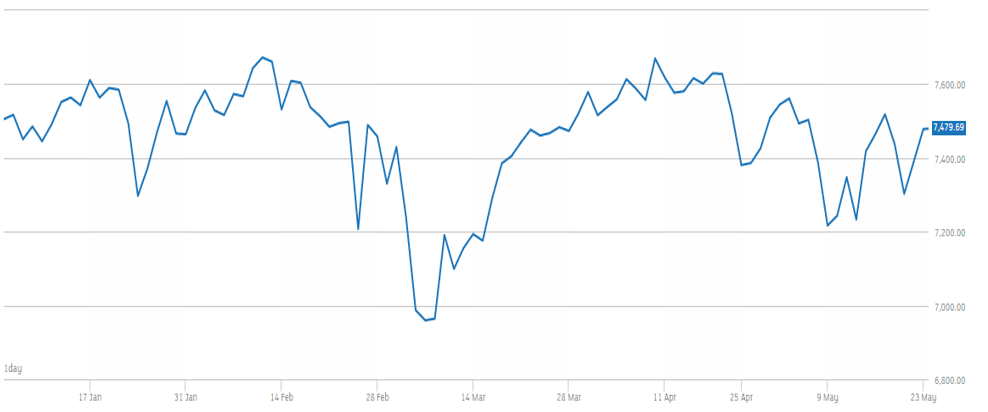
Here’s the performance of the FTSE 100 from the start of January to 23 May 2022.

Source: London Stock Exchange

If you’d decided to sell and exit the market at the start of March, you’d have missed out on the subsequent growth in April and May.

Secondly, while you may not “lose” money by keeping your wealth in cash savings, you are almost certainly eroding its value in real terms.

The latest Office for National Statistics (ONS) data shows UK inflation reached 9% in April. Compare this to the highest interest rate you can receive on easy-access cash savings in May 2022 which, according to analysts Moneyfacts, is just 1.25%.

  • If you save £100,000 at 1.25% you’ll earn £1,250 interest, so your cash in a year will be worth £101,250.
  • If inflation remains at 9%, £100,000 worth of goods and services now will cost £109,000 in 12 months’ time.
  • In real terms, keeping your wealth in cash has hugely eroded its buying power.

While it’s important to keep some money in cash – we can work with you to establish exactly how much – keeping too much in cash can slow your progress towards your long-term goals.

2. If your goals haven’t changed, neither should your plan

The key to successful financial planning is about establishing your goals and devising a plan that can help you to reach them. These might include protecting your loved ones, retiring early, or helping your children through education or onto the property ladder.

When we devise a plan, we factor in all sorts of unknown variables. These will include periods of investment uncertainty, inflation and, of course, changes to your own circumstances.

Remember: your plan already assumes that there will be tricky periods in the markets!

If your long-term goals haven’t changed since the start of the year, it’s unlikely that your plan will need to change either.

Your goals might be 10, 20 or even 30 years in the future, so the performance of the stock market in May 2022 is, in the overall scheme of things, not going to make an enormous difference to you meeting your goals.

Instead, have faith in the process, and in the plan. In the long term – and that’s what you’re likely to be investing for – markets tend to offer positive returns.

As Paul Samuelson said: “Investing should be more like watching paint dry or watching grass grow. If you want excitement, take $800 and go to Las Vegas.”

3. Investing after a downturn could provide rewards

Warren Buffett, often seen as one of the world’s leading investment gurus, has a useful quote for periods of economic uncertainty: “Be fearful when others are greedy, and greedy when others are fearful.”

What he means is that investing in a falling market can offer benefits when markets recover which, history tells us, they almost always do.

It’s impossible to guess when the bottom of the market is, even for experienced fund managers.

However, had you decided to take a contrarian view and invested after the significant downturn in the markets when the first lockdowns were mandated in March 2020, you’d have seen positive growth on your investments since that time.

Sometimes, looking at a period of uncertainty as a potential opportunity can change your mindset. Of course, you must remember that past performance is not a reliable indicator of future performance and that the value of your investment can go down as well as up and you may not get back the full amount you invested.

We’re here to help

Benjamin Graham once said: “The investor’s chief problem – even his worst enemy – is likely to be himself.”

When times are uncertain it’s easy to act on emotion. Your behavioural biases kick in, and you might make knee-jerk decisions that can impact your long-term goals.

That’s why we are here. We can chat through the current situation with you, review your plans and your goals, and give you the reassurance that you’re on course. And, if you’re not on track, we can take steps to ensure your goals remain attainable.

If you would like to chat to us about the current uncertainty, or you’d like to review your financial plan, please get in touch.

Please note

The value of your investment can go down as well as up and you may not get back the full amount you invested. Past performance is not a reliable indicator of future performance.

Written by SteveB · Categorized: News

May 31 2022

Your guide to inflation and how it can affect your wealth

In the 12 months to April 2022, the rate of inflation was 9%.

In simple terms, inflation means the cost of goods rise. The higher the rate of inflation, the quicker prices are rising. It can affect your day-to-day budget and your long-term wealth.

“Inflation is taxation without legislation.” – Milton Friedman, American economist, statistician, and recipient of the 1976 Nobel Prize in Economic Sciences

More than a fifth of people say the rising cost of living is the biggest threat to their personal finances in 2022. So, this guide can help you understand why inflation is an important consideration when making plans and what steps you can take to reduce the effect. It covers:

  • How the rate of inflation is calculated
  • Why the rate of inflation is higher than normal now
  • Whether the value of your assets has kept pace with inflation
  • Why inflation can mean your savings fall in value in real terms
  • How inflation can affect your spending power in retirement
  • And more…

Download “Your guide to inflation and how it can affect your wealth” to find out more about inflation and what it could mean for you.

If you have any questions about how inflation could affect your financial plan, please contact us.

Written by SteveB · Categorized: News

  • « Previous Page
  • 1
  • …
  • 50
  • 51
  • 52
  • 53
  • 54
  • …
  • 87
  • Next Page »
Ashworth Financial Planning Ltd is authorised and regulated by the Financial Conduct Authority. You can find Ashworth Financial Planning Ltd on the FCA register by clicking here. Registered in England & Wales. Company number: 08401597. Registered Office: Unit 1-1A, Park Lane Business Centre Park Lane, Langham, Colchester, Essex, England, CO4 5WR.

© 2026 · Ashworth FP · Legal · Web Design by D*Haus Agency