ASHWORTH

Financial Planning

  • Home
  • About Us
    • Stephen Buckle
    • Rachel Buckle
    • Wendy Bloomfield
    • Becky Evans
  • About You
    • People planning for retirement
    • People who have already retired
    • Business owners
  • What We Do
    • Financial Planning
    • How We Work
    • Investment Management
    • Solicitors & Accountants
  • Why choose us?
  • Case studies
  • News
  • Contact
  • Client Portal

Apr 04 2022

Investment market update: March 2022

Throughout March, the war in Ukraine continued to dominate headlines and affect investment portfolios around the world.

Many companies, from well-known businesses like L’Oréal and Coca-Cola to smaller firms, have withdrawn operations from Russia, including online sales. Others, such as Unilever and Nestlé, have halted investment in the country but are continuing to provide some goods.

This has led to some volatility within the markets, although they did rally towards the end of the month.

Sanctions on Russia mean the price of some goods have boomed globally. Aluminium reached a record high, and the price of fuel also climbed. As both Russia and Ukraine are major exporters of wheat and corn, the conflict may affect food prices too.

The ongoing uncertainty has played a role in the higher levels of inflation many countries are experiencing. The after-effects of the pandemic and the supply issues it caused are also partly to blame for inflation rates.

It’s natural to be worried about your plans during times of uncertainty. What’s important is that you keep your long-term plans in mind and don’t make knee-jerk decisions based on headlines. If you have any questions about your investment strategy or wider financial plan, please contact us.

UK

Chancellor Rishi Sunak delivered the spring statement on Wednesday 23 March.

He opened with subdued growth forecasts from the Office for Budget Responsibility (OBR). The organisation now expects GDP to rise by 3.8% in 2022, down from the 6% forecast in October last year. 

Among the measures Sunak announced were a fuel duty cut of 5p a litre as prices at petrol stations soared, and a cut in VAT for home energy efficiency installations.

While the government will continue with its plans to raise National Insurance (NI) in the 2022/23 tax year, the threshold that workers will start paying NI will increase.

The National Insurance Primary Threshold and Lower Profits Limit will rise from £9,880 to £12,570 from July 2022. Sunak also suggested that the basic rate of Income Tax could be cut in 2024, but only if certain conditions were met.

The statement followed the news from the Office for National Statistics (ONS) that in the 12 months to February 2022, inflation reached a 30-year high of 6.2%. The rate is now expected to peak at around 8%, but the Bank of England (BoE) hasn’t ruled out the possibility of double-digit inflation.

In a bid to slow the pace of inflation, the BoE also announced a base interest rate rise. It’s the third time the BoE has increased the rate since December 2021, and it now stands at 0.75%.

Inflation rising means that, in real terms, basic pay fell by 1% in the year to February – the steepest decline since 2014 – according to the ONS.

One of the biggest challenges families are facing is the rising cost of living, particularly energy prices. British wholesale gas for April delivery has increased by 20%. If prices remain high it could mean that household energy bills, which will be rising on average by 54% in April, will rise even further following the next review in October.

It’s an issue that is also affecting businesses. The Confederation of British Industry (CBI) has urged the government to offer support as energy bills rise. A CBI survey found that this pressure could lead to rising prices. 82% of British manufacturers expect to increase prices in the coming months.

As consumers are forced to cut back, some businesses are likely to find they’re affected by a reduction in discretionary spending.

Another news story that caught the attention of headlines was P&O Ferries’ decision to dismiss 800 members of staff and replace them with agency workers, who would earn less than the UK minimum wage. The decision caused outrage, prompted safety concerns, and led to suggestions that it may have been illegal.

Europe

Much like the UK, European economies are struggling with inflation and rising energy costs.

The European Central Bank (ECB) has raised its inflation forecast for 2022 to 5.8% compared to its earlier prediction of 3.2%. Again, energy prices are having a significant effect as costs increased by more than 30%.

Christine Lagarde, the president of the ECB, said the war in Ukraine “will have a material impact on economic activity through higher energy and commodity prices, the disruption of international commerce, and weaker confidence”.

However, unlike the BoE, the ECB elected to hold its interest rate at 0%.

The war in Ukraine has affected the outlook of Europe’s largest economy, Germany. A report from the Ifo research institute reported that business confidence in the economy has “collapsed” since the start of the conflict due to energy and supply chain challenges.

An agreed partnership between the European Commission and the US to reduce Europe’s reliance on Russian energy could relieve some of the pressure later this year. The US will aim to deliver larger shipments of liquefied natural gas to cut the European Union’s dependency on Russian Gas by two-thirds this year and end it before 2030.

After limiting activity for a month, the Moscow stock exchange reopened on Monday 28 March. Unsurprisingly, stocks fell but measures were put in place to prevent a sharp sell-off, including banning foreigners from selling Russian shares.

US

Inflation in the US increased to 7.9% in the 12 months to February 2022 – a 40-year high – according to the Labor Department.

The rising cost of living is having a knock-on effect on consumer confidence. A barometer from the University of Michigan found falling incomes in real terms means consumer sentiment has fallen to an 11-year low.

Despite the challenges, employment statistics indicate that businesses remain confident. The unemployment rate fell to 3.8% after firms took on 678,000 workers, far higher than the 400,000 expected, according to the Bureau of Labor Statistics.

US technology companies Alphabet (Google) and Meta (Facebook) are facing an antitrust investigation launched by the EU and UK. The two firms are accused of colluding to carve up the online advertising market between them. The deal between the two firms is already under investigation in the US. If found to be illegal, the deal, called “Jedi Blue”, could result in hefty fines of up to 10% of their global turnover.

Please note: This blog is for general information only and does not constitute advice. The information is aimed at retail clients only. The value of your investment can go down as well as up and you may not get back the full amount you invested. Past performance is not a reliable indicator of future performance.
Written by SteveB · Categorized: News

Apr 04 2022

Doctor’s orders: Why medical professionals are prescribing trips to national parks

When you go to the doctor feeling under the weather, what do you expect? A prescription to take to the pharmacy or some additional tests perhaps?

Doctors in Canada are taking another approach by handing out passes to the country’s stunning national parks to improve the health of some of their patients.

The initiative, called “PaRX”, encourages patients to get outdoors and enjoy nature more. Medical professionals give patients a free pass to enter stunning and vast natural places, like Glacier National Park of Canada, which is renowned for its deep valleys filled with ancient forests, as well as nature reserves, gardens, and historic sites. 

PaRX claims that people who spend at least two hours in nature a week report significantly better health and wellbeing than those who don’t. So, that’s what patients are prescribed – to explore the great outdoors for two hours a week.

The initiative adds: “From diabetes and heart disease to anxiety and depression, research shows that connecting to nature is a powerful way to improve your health.”

5 surprising health benefits of spending more time outdoors 

While we know getting outdoors can encourage physical activity that’s important for overall health, there may be some benefits to visiting national parks and other green spaces that surprise you. 

There have been hundreds of studies exploring the health benefits of nature. The programme in Canada uses some of this research to support the PaRX initiative after they found:

  • 90% of people say they’re happier when they’re outside – and stress hormone levels drop significantly after just 15 minutes of sitting in a forest.
  • Increasing how much time you spend in nature reduces your risk of developing heart disease, high blood pressure and diabetes. 
  • Spending time in nature can boost your creativity, memory, and work satisfaction.
  • Seniors who live closers to walkable green spaces live longer. 
  • Being in a forest drops inflammation and stress in adults with some lung conditions and reduces the risk of lung infections. 

It’s not just adults who benefit from exploring the great outdoors. Research suggests young people who spend time in nature are more resilient and experience less anxiety, as well as being more likely to reach physical activity targets to maintain a healthy body. 

Canada isn’t the first country to change how it thinks about healthcare to incorporate nature. 

The Canadian model follows a similar programme in the US, while a practice known as “forest bathing” has become an important part of preventive healthcare in Japan. 

While the UK has yet to offer national park prescriptions, that doesn’t mean you can’t enjoy the benefits. We might not have glaciers here, but our varied landscape and beautiful outdoor spaces are excellent places to explore to boost your wellbeing. 

The 15 stunning national parks of the UK

There are 15 national parks spread out across the UK and they are free to visit at any time of the year.

With an estimated 110 million visits to the national parks each year, many people are already benefiting from the positive health effects of being outdoors. So, if it’s been a while since you visited one of these outdoor spaces, why not plan a trip?

Here are the 15 national parks you can visit in the UK:

  1. Peak District
  2. Lake District
  3. Snowdonia
  4. Dartmoor
  5. Pembrokeshire Coast
  6. North York Moors
  7. Yorkshire Dales
  8. Exmoor
  9. Northumberland
  10. Brecon Beacons
  11. The Broads
  12. Loch Lomond and The Trossachs
  13. Cairngorms
  14. New Forest
  15. South Downs

On top of the national parks, the UK has numerous places designated as Areas of Outstanding Natural Beauty for excellent countryside walks, as well as country parks, formal gardens, historic sites, and outdoor spaces in urban areas. 

So, there are plenty of opportunities to follow the lead of Canada and set a goal of spending at least two hours a week in nature. It could lead you to new destinations across the UK, improve your mood, and help you be healthier.

Written by SteveB · Categorized: News

Apr 04 2022

3 interesting pieces of data that show why you shouldn’t panic during market volatility

Over the last two years, investors have experienced a lot of volatility. If you’ve been tempted to change long-term plans, data can highlight why you shouldn’t panic.

At the start of the Covid-19 pandemic, markets fell sharply, and investors continued to experience volatility as the situation and restrictions changed. Just as things were slowly getting back to “normal”, tensions with Russia began to rise and stock markets reacted strongly when Russia invaded Ukraine in February.

Seeing the value of your investments fall can be nerve-racking, so much so that you may be tempted to make withdrawals or changes to your portfolio.

While there are times when it may be appropriate to change your investments, changes should reflect your personal circumstances. They shouldn’t be a knee-jerk reaction to periods of volatility.

Tuning out the noise and looking at long-term investment trends can be easier said than done. So, these three pieces of data can help you see why, in most cases, sticking to your investment strategy is the best option.

1. Stock market risk falls the longer you invest

All investments carry some level of risk, and the value of your investments can fall.

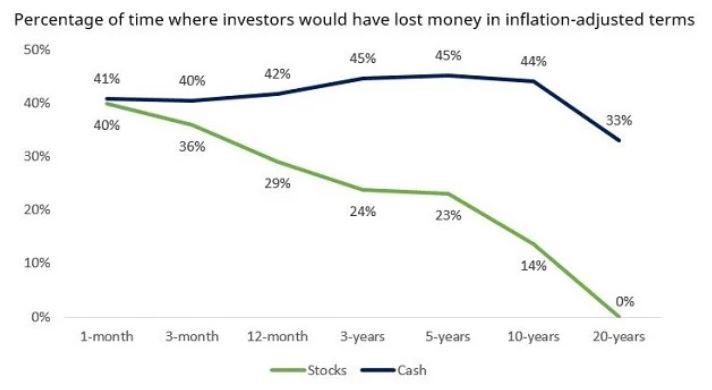
However, over the long term, the ups and downs of investment markets can smooth out. This means that the longer you invest, the less risk there is that you will lose money when you look at the long-term outcomes. This is why you should invest for a minimum of five years. The below graph shows how the risk of losing money overall falls when you invest for a longer period. This compares to holding cash, which can lose value in real terms as the cost of living rises, which interest rates are unlikely to keep up with.

Source: Schroders

So, while you may think about withdrawing your money amid volatility, leaving your money invested could reduce the risk of your portfolio falling in value.

Your investments should reflect your risk profile, which considers several factors, such as your goals and capacity for loss.

2. Markets have historically bounced back

When you’re experiencing volatility, it can seem like a one-off event. Yet, if you look back over the years, you’ll see there are often events that can seem like reasons not to invest or to change your investment strategy.

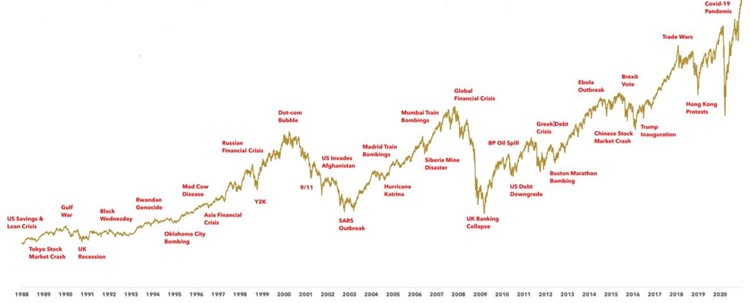
In the last decade alone, there’s been the Brexit vote, Trump’s inauguration, trade wars, and protests in Hong Kong.

During these periods, your investments may have fallen in value. Yet, if you review the long-term trend, markets have historically bounced back and gone on to deliver returns. The graph below highlights how negative world events can cause stock markets to fall.

Source: Bloomberg, Humans Under Management. Returns are based on the MSCI World price index from 1988 and do not include dividends. For illustrative purposes only.

While there have been sharp falls, the general trend of stock markets has been upwards over the last 30 years.

Data from Schroders shows that stock market corrections, where there is a 10% drop, are not as rare as you might think either. The US market has fallen by at least 10% in 28 of the last 50 calendar years. Yet even with these dips, the market has returned 11% a year over the last 50 years on average.

3. Trying to time the market could cost you money

As stocks rise and fall, it can be tempting to try and time the market.

Everyone wants to buy stocks at a low price and sell them when the value is high. But it’s incredibly difficult to consistently predict how the markets will change.

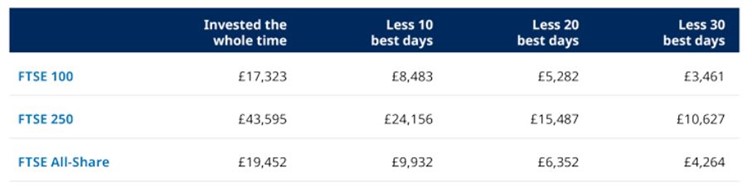
Even if you miss out on just a handful of the best performing days of the market, you could lose out. The below table shows the returns from an investment of £1,000 between 1986 and 2021 based on leaving your money invested and missing some of the best days.

Source: Schroders

If you had invested in the FTSE 250, missing just the 30 best days over these 35 years would cost you almost £33,000.

The findings highlight why “it’s time in the market, not timing the market” is a common saying when investing. Staying the course and having faith in your long-term investment strategy makes sense for most investors.

Creating an investment strategy that’s right for you

The above graphs and table highlight why you shouldn’t panic when investment markets experience volatility.

That being said, it’s important to remember that investment performance cannot be guaranteed, and that past performance is not a reliable indicator of future performance.

Building an investment portfolio that reflects your goals and takes an appropriate amount of risk is crucial. If you’d like to talk about investing, whether you have concerns about market volatility or want to start a portfolio, please contact us.

Please note: This blog is for general information only and does not constitute advice. The information is aimed at retail clients only.

The value of your investment can go down as well as up and you may not get back the full amount you invested. Past performance is not a reliable indicator of future performance.
Written by SteveB · Categorized: News

Apr 04 2022

“Midlifers” are hit by time and financial pressures. Financial planning can help balance your priorities

Individuals aged between 40 and 60 – dubbed “midlifers” – are facing time and financial pressures as they try to support their families. Many are feeling the strain and don’t have the resources to focus on their own goals, and financial planning could help.

According to a survey from Legal & General, 6 million midlifers are finding themselves caught in the middle of providing financial support to adult children and providing unpaid care to ageing relatives. On top of this, it’s a crucial period for securing their own financial future and retirement.

The research found 17% of midlifers provide financial support to another adult, totalling £10 billion a year.

  • Those supporting grown-up children provide, on average, £247 a month.
  • Midlifers financially helping elderly parents or other relatives spend, on average, £282 a month.

The findings suggest that at age 45, you’re likely to have the greatest level of financial responsibility, while age 58 is when you’re most likely to start taking on some care responsibilities.

It’s natural to want to lend support to your loved ones, but it can harm your own lifestyle and long-term goals. While retirement can seem a long way off when you turn 40, it’s an important milestone to start thinking about. The steps you take now could affect the lifestyle you enjoy in your later years.

10% of midlifers feel the level of support they provide is unsustainable

The research worryingly found that 10% of midlifers feel that the support they provide is already unsustainable. If you’re supporting loved ones, a financial plan can help make it part of your budget and balance the support with other priorities.

If you’re neglecting your pension or other steps that could improve your long-term financial wellbeing, financial planning can help highlight potential challenges in the future and show you how to reduce risks. It means you’re in a better position to meet the demands you’re facing now and still secure your future.

It can also help you make decisions about the financial support you’re offering.

For instance, if you’re helping adult children with rental costs, would providing a lump sum to act as a house deposit make more sense? It could reduce their outgoings overall and provide long-term stability. It’s an option you may have dismissed or not even considered, but we can help you review your finances to see if it’s right for you.

If you’re struggling to provide care for a loved one, paying for some professional support can also make sense. This doesn’t have to mean a care home but could be someone that checks in with them every day. It can relieve some of the pressure you may be feeling while still ensuring your loved one is getting the additional support they need.

A financial plan can help you confidently support the people who are important to you.

19% of midlifers spend no time on their own financial wellbeing

As well as having a direct effect on expenses and how your money is used, supporting others can reduce the amount of time you have to organise your own life.

25% of people aged between 40 and 60 said they get less than an hour to themselves in the average day. Almost a fifth (19%) said they have no time to spend on their own financial wellbeing.

Financial planning doesn’t just provide you with a plan to reach your long-term goals. It can help you make the most of your time and reduce how much admin you need to do to stay on track.

As your financial planner, we can provide you with confidence in your financial future and set regular reviews, so you don’t have to worry about how your pension is performing or whether you have adequate financial protection day-to-day. This step means you can focus on what’s important now while knowing that your long-term financial wellbeing is secure.

Financial planning can help you get the most out of your money and time. Please contact us to arrange a meeting. 

Please note: This blog is for general information only and does not constitute advice. The information is aimed at retail clients only.

Written by SteveB · Categorized: News

Apr 04 2022

HMRC refunds £42 million in overpaid tax to pensioners. Have you paid too much?

When you retire, your income may be coming from multiple sources, and it may not be regular. This can lead to some retirees being overtaxed. While you can claim back overpaid tax, it could affect your plans and you may not realise you’ve paid too much.

Understanding your tax liability can help you manage your budget and income in retirement.

Retirees have overpaid around £835 million in tax since 2015

In the last quarter of 2021 alone, HMRC returned more than £42 million in overpaid tax to those accessing their pension, according to an FTAdviser report.

Retirees affected, on average, will receive a rebate of £3,107.

Since the government introduced Pension Freedoms in 2015, which allows retirees to access their savings flexibly, HMRC has repaid around £835 million in overpaid tax.

Overpaying tax is common among retirees because of the way the tax system works, and there have been calls for it to be updated to reflect the 2015 pension reforms.

The issue arises if you’ve not been given a tax code by HMRC. This can mean you’re given an emergency tax code that assumes you’ll make the same withdrawal each month.

So, if you withdraw a lump sum from your pension to pay for one-off expenses or to last for several months at the start of the tax year, the system assumes you will do this each month. As a result, you may pay too much tax.

Let’s say you withdraw £20,000 from your pension in April as you want to help your child get on the property ladder by gifting a deposit. The system may tax this withdrawal as though you’re going to withdraw an annual income of £240,000.

So, you could end up paying far too much tax if your initial withdrawal doesn’t accurately reflect the income you’ll take from your pension over the tax year.

How much tax do retirees pay?

To understand if you’ve overpaid tax, you need to start with your tax liability.

First, you can typically take up to 25% of your pension tax-free. You can either take this as a lump sum or spread it out.

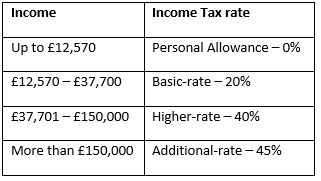
For any other withdrawals you make from a defined contribution (DC) pension, you may be liable for Income Tax. Your retirement income is taxed in the same way as your income was when you were working. The below table shows the 2022/23 Income Tax rates.

Keep in mind that you need to consider all forms of income, not just withdrawals you make from your DC pension. So, if you receive income from a defined benefit (DB) pension, rental properties, or investment portfolio, for example, you could be liable for a higher rate of tax.

In retirement, your income may be complex, and it may come from multiple sources. It can be difficult to keep track of your income and tax liability. We’re here to help you understand what tax you need to pay and how to make use of allowances to make your money go further.

How to reclaim overpaid Income Tax

If you’ve overpaid tax, don’t panic.

If you discover you’ve overpaid tax, you can apply for the money back now and HMRC will return it within 30 days. You will need to fill in a form to apply, which you can do online or through postal forms. Which form you need to complete will depend on your circumstances:

  • P55 – If you’ve taken an income from your pension but have not emptied it.
  • P50Z – If you have emptied your pension and have no other taxable income in the same tax year.
  • P53Z – If you’ve emptied your pension and have other taxable income.

You will need to provide information about how much you withdrew from your pension and the tax you paid. HMRC will then calculate what you’re owed.

Even if you don’t realise you’ve overpaid, you will receive a refund automatically at the end of the tax year. This means you could be waiting almost a full year to get your money back if you don’t spot the error.

While you will receive overpaid tax back, it can be frustrating, and it may affect your plans if it’s not something you’re expecting. Working with us can help you minimise the chance of overpaying Income Tax and mean that you’re aware as soon as possible if it does happen.

If you’d like to discuss your retirement income and how much tax you could pay, please contact us.

Please note: This article is for information only. Please do not act based on anything you might read in this article.

All contents are based on our understanding of HMRC legislation, which is subject to change.

The Financial Conduct Authority does not regulate tax planning.

Written by SteveB · Categorized: News

Apr 04 2022

Why good retirement planning is about more than your pension and money

If you’re nearing retirement, you may be starting to think about planning the next stage of your life.

What steps spring to mind? You may prioritise organising your pension, claiming your State Pension, or reviewing how much you have in a savings account. These steps are important for creating security, yet good retirement planning goes further than your finances.

So, what should retirement planning include? Setting out lifestyle goals is crucial for building a retirement plan that means you get the most out of your life.

Here are five questions that you should think about as you approach retirement. They can also help you get the most out of the financial planning process by ensuring your aspirations are at the heart of any decisions you make.

1. What are you looking forward to in retirement?

If you’re nearing retirement, you may be excited about the next stage of your life. Setting out what it is you’re looking forward to can help you make decisions that are right for you.

According to the Great British Retirement Survey from interactive investor, 49% of people that haven’t yet retired are looking forward to greater freedom and 42% see retirement as an opportunity for a new business or hobbies.

3 in 10 people still working think their life will improve when they retire. Pinpointing what it is that will make retirement an exciting milestone for you is crucial.

2. How will you fill your days when you retire?

While you may have big plans for your retirement, it can be easy to overlook the day-to-day when you set out your lifestyle.

Going from working full-time to having freedom can be overwhelming at first. Some retirees can find they don’t know how to fill their days initially and you may need a period of adjustment. By setting out how you’d like to spend your time before you retire, you can start building a retirement lifestyle that you find fulfilling.

3. What will give you purpose in retirement?

Much like filling your days, retiring can pose a challenge for some retirees if they feel like they’ve lost their purpose and drive when giving up work.

According to an Aegon report, just 4 in 10 people think about what gives their life joy and purpose.

Considering your driving force is a useful exercise at any point in your life and reviewing this as you retire is an important task.

4. How will you maintain social connections in retirement?

Work can play a pivotal role in your social life. So, when you retire, it can leave a gap.

Thinking about how you’ll maintain or create new social connections can improve your retirement lifestyle. That may mean making sure you stay in touch with family and friends or planning ways to get out of the house to meet new people, like joining a club that interests you.

Research from the National Institute for Health Research found that 1 in 3 people aged 50 years and over in the UK report feeling lonely. A lack of social connections can harm your mental health and has been linked to depression, so your social life in retirement is vital for your overall wellbeing and happiness.

5. Do you have any concerns about retirement?

While you may be looking forward to retirement, it’s natural to have some concerns too.

From worries about your finances to being anxious about the lifestyle change, thinking about your concerns is as important as setting out what you’re looking forward to.

It means you can address any worries that you have and put a plan in place to deal with them. By being proactive, you can really focus on enjoying your retirement to the fullest.

Using your lifestyle goals to shape your financial decisions

Lifestyle aspirations play a crucial role in effective retirement planning, but getting to grips with the finances remains important.

Having a clear idea about what you want to get out of retirement can help shape your financial decisions so they reflect your priorities.

If you want to see more of the world when you initially retire, taking a larger income from your pension during the first few years could make sense. Or if you hope to make workshops, classes, and hobbies a regular part of your schedule, including these costs in your budget can ensure you’re able to fill your days how you want.

By combining lifestyle and finances when you’re retirement planning, you can have confidence in the decisions you make. Please contact us to discuss your retirement and the lifestyle you’re looking forward to.

Please note: This blog is for general information only and does not constitute advice. The information is aimed at retail clients only.

Written by SteveB · Categorized: News

  • « Previous Page
  • 1
  • …
  • 52
  • 53
  • 54
  • 55
  • 56
  • …
  • 87
  • Next Page »
Ashworth Financial Planning Ltd is authorised and regulated by the Financial Conduct Authority. You can find Ashworth Financial Planning Ltd on the FCA register by clicking here. Registered in England & Wales. Company number: 08401597. Registered Office: Unit 1-1A, Park Lane Business Centre Park Lane, Langham, Colchester, Essex, England, CO4 5WR.

© 2026 · Ashworth FP · Legal · Web Design by D*Haus Agency