ASHWORTH

Financial Planning

  • Home
  • About Us
    • Stephen Buckle
    • Rachel Buckle
    • Wendy Bloomfield
    • Becky Evans
  • About You
    • People planning for retirement
    • People who have already retired
    • Business owners
  • What We Do
    • Financial Planning
    • How We Work
    • Investment Management
    • Solicitors & Accountants
  • Why choose us?
  • Case studies
  • News
  • Contact
  • Client Portal

Mar 09 2022

Why retirees need to consider the effect of inflation on their long-term income

As you may know, inflation (or the “cost of living”) has been rising at a faster pace than usual. If you’re retired, the effect of inflation can be more pronounced and it’s important to understand how it could affect your lifestyle now and in the future.

The Bank of England (BoE) aims to keep inflation at 2% a year. However, according to the Office for National Statistics, the rate of inflation in the 12 months to February 2022 was 6.2%. While the effect of inflation can seem small day-to-day, it adds up.

Why inflation is important if you’re a retiree

If you’ve already retired, inflation can affect your lifestyle more than if you were still working. This may be because your income is static rather than rising with inflation. You may also need to consider how you will use your assets over your retirement. Taking more now to ensure your income rises in line with inflation could mean you face a shortfall in the future.

In addition, energy and food are two of the areas that inflation has affected the most. Traditionally, pensioners have spent a larger part of their income on these two expenditures than workers. So, rising inflation could affect your expenses more than you expect.

While the State Pension will rise in the new tax year in April, it won’t rise at the same pace as inflation. For the 2022/23 tax year, the State Pension will increase by 3.1%. This is because it will rise by the rate of inflation as measured in September 2021.

According to the Centre for Economics and Business Research, the gap between the State Pension increase and the current pace of inflation will mean pensioners are £169 a year worse off in real terms. 

So, if you’re retired, what can you do about inflation?

5 things retirees should do to manage the effects of inflation

1. Review your income needs

Looking at how your expenses have changed over the last few months can help you create a realistic budget. Does your current income still allow you to live the same lifestyle, or have you had to make adjustments? Looking at which outgoings have increased can help you see if you need to make any changes.

2. Check your reliable sources of income

As part of your retirement income, you may have some sources that provide a reliable income. You should review these and check if they’ll increase in line with inflation in the new tax year.

As mentioned above, the State Pension will rise but not at the same pace as inflation. You may also have a defined benefit (DB) pension, which pays a guaranteed income throughout retirement. A DB pension will often increase at the same pace as inflation, providing you with some financial security even as the cost of living rises.

If you had a defined contribution (DC) pension, you may have chosen to purchase an annuity that will pay an income for the rest of your life. When purchasing an annuity, you can choose whether the income will increase in line with inflation.

3. Assess investment performance if you’re using flexi-access drawdown

If you have a DC pension, an alternative to an annuity is flexi-access drawdown. This option allows you to take a flexible income, with the rest of your pension usually remaining invested. As a result, the remainder of your pension may increase to keep pace with inflation depending on how the investments perform.

In addition to investments held in a pension, you may also have a separate investment portfolio that could deliver growth that matches or exceeds inflation.

Investing can provide you with a chance to grow your wealth, but you should keep in mind that returns cannot be guaranteed.

4. Review your cash savings

Some cash savings are important as they can provide a valuable safety net if you face an unexpected expense. However, as inflation is likely higher than the interest rate you are earning on your cash savings, the value of your savings could be falling in real terms.

In some cases, moving the money to a different account or investing a portion of the savings can help you reduce the effects of inflation on your wealth.

5. Arrange a meeting with your financial planner

If you’d like help in understanding how inflation is affecting your income now, and the effect it could have in the future, a meeting with a financial planner can help. Please contact us to discuss your income needs and what you can do to protect against the effect of inflation.

Please note: This blog is for general information only and does not constitute advice. The information is aimed at retail clients only.

A pension is a long-term investment not normally accessible until 55 (57 from April 2028). The fund value may fluctuate and can go down, which would have an impact on the level of pension benefits available. Past performance is not a reliable indicator of future results.

The tax implications of pension withdrawals will be based on your individual circumstances. Thresholds, percentage rates and tax legislation may change in subsequent Finance Acts. 

The value of your investment can go down as well as up and you may not get back the full amount you invested. Past performance is not a reliable indicator of future performance.
Written by SteveB · Categorized: News

Feb 03 2022

Investment market update: January 2022

While many countries have now eased Covid-19 restrictions, the knock-on effects of lockdown continue to affect economies, businesses, and households.

According to the Organisation for Economic Co-operation and Development (OECD), inflation in the 38 richest countries has reached 5.8% – a 25-year high. The findings also highlight the driving forces behind inflation rates. If food and energy are excluded, year-on-year inflation is a more modest 3.8%.

Global demand for gas and oil, along with rising carbon prices, means that energy bills for businesses and families are increasing. In the UK, rapidly rising prices have led to more than 20 energy firms collapsing, and other countries are facing similar challenges. According to a report from Bloomberg, households in Europe could see average energy prices increase by up to 54% when compared to bills two years ago.

The United Nations (UN) also reported that world food prices have surged by 28% and affected all major food groups. The price increase has been linked to strong demand, supply chain issues, poor weather, and rising operational costs.

UK

In December, the Omicron variant of Covid-19 began to spread in the UK. This led to prime minister Boris Johnson announcing “Plan B”, which reintroduced some of the restrictions and guidelines previously lifted, such as wearing face masks and encouraging employees to work from home where possible.

The decision affected service sector growth, which fell to a 10-month low. According to IHS Markit Purchasing Managers’ Index (PMI) data, the reading fell from 58.5 in November to 53.6 in December. A figure above 50 indicates growth, but the latest update suggests the pace is slowing.

It’s not just Covid-19 that is affecting businesses in the UK; the effects of Brexit are playing a role too.

According to a snapshot from the Chartered Institute of Procurement and Supply (CIPS), UK factory output was limited at the end of 2021 due to Covid restrictions, and Brexit pushed up costs. Research from Euler Hermes also supports this: the credit insurance lender states that Britain’s exporters are on track to be the slowest among big European economies to recover from the effects of the pandemic.

With this in mind, UK factories are set to increase prices at their fastest rate since 1977. The CBI’s industrial trends survey found that 66% of firms expect to hike domestic prices in the first quarter of 2022 amid a skills shortage.

Retail figures released from the Christmas period paint a gloomy picture. Retail sales across the UK fell by 3.7% in December, which could severely affect businesses that rely on a busy trading period over the festive season. Adding to these woes, a consumer confidence index from GfK suggests that people are less optimistic about their financial position and the wider economy, which could lead to subdued spending.

Rising inflation is likely to be one of the factors affecting consumer confidence. Data from the Office for National Statistics show that wage growth has fallen below inflation. Average basic pay, which does not include bonuses, increased by 3.8% between September and November 2021. This means a real-terms loss when inflation of 5.1% is considered.

Moving on to the housing market, homeowners have benefited from prices surging. In 2021, the average house price increased by 9.8%. While housebuilders also benefit from rising prices, the sector has been dealt a blow. Shares in UK housebuilders fell after the government ordered the industry to pay £4 billion to help remove dangerous cladding from buildings following the Grenfell disaster in 2017.

Car sales also continue to lag behind previous figures, despite the economy reopening. Annual sales data from the Society of Motor Manufacturers and Traders found that car sales increased by just 1% year-on-year in 2021 and remain almost a third below the total sales for 2019. Electric vehicle figures do provide some good news though. Britons bought more electric cars in 2021 than in the previous five years combined.

Europe

In contrast to car sales figures from the UK, German carmaker BMW has reported record sales of more than 2.2 million in 2021, despite global chip shortages.

While the above and unemployment figures are positive for Germany, official data shows that the economy shrank by 0.7% between October and December 2021. As the biggest economy in the eurozone, Germany is often used as a bellwether for the economic area. However, in spite of this, France, Spain, and Italy posted growth for the final quarter of 2021.

IHS Markit data suggests that the private sector across the EU is experiencing a slowdown, although it’s still in growth territory.

US

Data and news from the US are similar to the UK.

Inflation in the US hit 7% in January, the highest level since 1982. This has had a knock-on effect on consumer confidence. Research from the Conference Board suggests that Americans are growing less optimistic about short-term prospects.

This sentiment is likely to have affected consumer spending too. Retail sales in the US were less than expected and fell by 1.9% in December. Once cars and gasoline are removed from the calculation, spending falls to 2.5%. Again, this means spending fell during the crucial festive period and could place businesses under pressure.

However, findings suggest that US businesses remain optimistic. Payroll processing firm ADP said US companies hired twice as many people as expected in December, signalling they are confident about the economy.

Please note: This blog is for general information only and does not constitute advice. The information is aimed at retail clients only. The value of your investments can go down as well as up and you may not get back the full amount you invested. Past performance is not a reliable indicator of future performance.

Written by SteveB · Categorized: News

Feb 02 2022

Is the interest rate rise good news for savers?

After more than a decade of low interest rates, the Bank of England (BoE) has suggested that it will continue to gradually increase its base rate. With savers suffering from low returns, is that good news?

In December 2021, the BoE increased its base rate from 0.1% to 0.25%. While still very low compared to the Bank’s base rate historically, it’s the highest it has been since the start of the pandemic in 2020. Interest rates have been low since the 2008 financial crisis, when the BoE reduced rates in a bid to support the economy. As the UK recovers from the pandemic, the base rate could steadily begin to climb.

While, on the surface, the rate hike looks like good news for savers, it may not be as positive as it first seems.

To start with, the interest you’re receiving on your savings may not have increased following the announcement. According to a Guardian report, five weeks after the BoE announcement just four financial firms had passed on the full rate rise to all, or nearly all, of their variable-rate savings account customers. So, you may not have seen a change in the interest your savings are delivering at all.

Why does inflation exceeding 5% reduce the real-terms value of your savings?

One of the key reasons behind the decision to increase the interest base rate was rapidly rising inflation.

In the 12 months to December 2021, inflation hit its highest rate for 30 years. The rate of annual inflation was 5.4%, which means that the cost of living has increased much faster than the BoE’s target of 2%. At the current pace of inflation, something that cost £1 last year will now cost £1.05. That may not seem like a huge difference but when it’s across all your spending, from holidays to electricity, it adds up and can place pressure on your finances.

Inflation doesn’t just affect your day-to-day budget either – it also affects the spending power of your savings.

While the money sitting in your account doesn’t decrease, its spending power does if the interest earned is lower than inflation. So, unless your savings are earning interest above 5.4%, they are losing value in real terms as you’ll be able to buy less with that money.

Again, it’s something that can seem insignificant when you first look at it. However, over a sustained period, it does affect the value of your savings.

The BoE’s inflation calculator demonstrates this. If you had £20,000 in a savings account in 2010, it would need to have grown to £26,225.20 in a decade to maintain its spending power. This is because the average annual inflation was 2.7%. Now imagine how much your savings would need to grow to keep pace with inflation of 5.4%.

So, what can you do to maintain the value of your savings? Investing could provide a solution.

First, it’s important to note that cash savings can still play an important role in your overall financial plan. For example, your emergency fund should be readily accessible in case you need it, so a cash account often makes sense, even if interest rates are low.

When does investing make sense as a strategy to beat inflation?

Investing can help your savings to grow at a pace that maintains or exceeds the rate of inflation. As a result, it can help you maintain or grow your spending power over time. However, it does come with risks.

The value of investments can rise and fall, and you will experience periods of volatility, so investing should be done with a long-term outlook. If you’re saving for goals that are more than five years away, whether that’s helping children get on the property ladder or planning for retirement, it can make sense. If your savings are for short-term goals, like going on holiday, investing may not be right for you.

This is because a long-term time frame gives the peaks and troughs of market movements a chance to smooth out. If you’re investing for a short-term goal, what happens if you need the money at a point when your investment values fall? It could mean you have to cancel plans or sell more units to achieve the same goal, which could have a knock-on effect for other goals.

If you already have a rainy day fund for unexpected costs and plan to save for more than five years, it is worth thinking about whether investing is appropriate for you. We understand that you may have concerns about investing and the associated risks, but we’re here to offer you support in understanding your risk profile, choosing investments, and reviewing their performance. Please contact us to discuss what steps you can take to reduce the effect of inflation on your wealth.

Please note: This blog is for general information only and does not constitute advice. The information is aimed at retail clients only.

The value of your investment can go down as well as up and you may not get back the full amount you invested. Past performance is not a reliable indicator of future performance.

Written by SteveB · Categorized: News

Feb 02 2022

Half of investors admit to making impulsive, emotional decisions, and many go on to regret it

While investment decisions should be based on facts, many investors find their decisions are sometimes influenced by emotions. Whether you’re excited about an investment opportunity, or worried about market volatility, keeping emotions in check can help you make better investment decisions.

According to research from Barclays, half of investors admit to making impulsive decisions based on their emotions. While these decisions can seem right at the time, 67% of investors said they go on to regret their choice. Worries during short-term market volatility are often associated with making knee-jerk decisions. If you see the value of your investments fall, it’s natural to want to make changes. However, the study found that other emotions play a role in impulsive investment decisions, including:

  • Excitement (34%)
  • Impatience (21%)
  • Fear (16%)

Letting emotions play a significant role in your decisions can mean you make choices that you wouldn’t normally or that don’t fit into your financial plan.

What can you do to reduce impulsive investment decisions?

While you can’t remove the emotions you feel when investing, there are things you can do to reduce the chance of you making impulsive decisions and recognise when emotions are affecting your thought process.

1. Keep in mind where you get information from

In modern life, you’re surrounded by news and information that could affect how you view your investments. It’s important to keep in mind how reliable the information is and how it relates to your circumstances.

When asked what influenced their investment decisions, 32% of respondents said “social media” and 31% said “friends”. While both of these can be useful sources of information, they can also lead to you making decisions that aren’t right for you. Such information may be inaccurate or biased. There’s no one-size-fits-all strategy when investing either. So, while a friend may have made an investment decision that’s right for them, it doesn’t automatically mean it makes sense for you too.

Taking a step back before you make an investment decision can help you review what it’s based on and how reliable the source is.

2. Have faith in your investment plan

Almost a third (30%) of investors said they’d made an impulsive investment decision due to the “fear of missing out” (FOMO). If you’ve heard of a great investment opportunity, it can be tempting to invest yourself. While some of these may be a good option for you, it’s important not to be impulsive and to weigh them up carefully. Having confidence in your financial plan can help you look at opportunities objectively and see how they’ll fit into your long-term goals.

3. Keep your long-term goals in mind

Investing can involve a lot of ups and downs. That’s why a long-term plan is important. Ideally, you should invest with a minimum time frame of five years with an investment strategy that reflects this. However, it can still be easy to let short-term market movements affect your decisions and how confident you feel about the decisions you’ve made.

The survey found that 6 in 10 investors feel like they need to constantly monitor their investments. Keeping an eye on performance can ease feelings of anxiety you may have if investments have increased in value or remained stable. However, it can also mean you’re more prone to reacting to short-term fluctuations in the market. While investment values may fall, historically, markets have recovered.

While guarantees can’t be made when investing, it’s important to review your investments with a long-term outlook. Reacting to short-term falls could mean you miss out on long-term gains and harm your overall plan. That’s not to say that you should never make changes to your investment portfolio, but, rather, these decisions should be based on information rather than emotions.

Working with a financial planner can help give you confidence in your financial plan. It also means you have someone to talk to if you’re thinking about making changes to your investment strategy, whether based on emotions or other factors. If you’d like to discuss your investments and how they can help you achieve your aspirations, please contact us.

Please note: This blog is for general information only and does not constitute advice. The information is aimed at retail clients only.

The value of your investment can go down as well as up and you may not get back the full amount you invested. Past performance is not a reliable indicator of future performance.

Written by SteveB · Categorized: News

Feb 02 2022

Only 55% of people want to split their estate evenly between their children

When thinking about how parents will split their assets between children, it’s often assumed wealth will be evenly distributed. However, a survey suggests that, for a variety of reasons, a significant proportion of inheritances may not be.

According to a report in Money Age, just 55% of UK adults plan to split their wealth equally among their children. If you don’t want to split your estate evenly, it can make writing your will and estate planning more complex. It’s important to think about how you’d like your assets to be distributed to ensure your wishes are carried out. Here are three reasons you may not want to split your estate evenly between your children when you pass away.

1. You want to reflect gifts provided during your lifetime

It’s becoming more common for parents to provide financial gifts or support during their lifetime. This could be to help children achieve a specific milestone, like buying their first home, or for other estate planning purposes, like reducing Inheritance Tax.

A survey from Canada Life suggests that over a third of parents have already passed on significant gifts to the next generation. If you’ve provided gifts to a child already, you may want to reflect this in your will. 13% of parents said they would consider the financial support already given when setting out inheritances for their children.

If this is something you’d like to consider in your will, it’s important to keep track of the gifts provided. It’s also a good idea to schedule regular reviews, as the value of your assets may change and alter how you’d like to distribute them.

2. You want to reflect each child’s circumstances

You may also want to reflect on the circumstances of each child when deciding how to support them with an inheritance. If one child is less financially secure and so needs more support, you may decide to leave a greater proportion of your estate to them.

As with the above, if this is your goal, regular reviews are important, as your children’s circumstances can change, as can your assets.

3. You want to pass on a certain asset to one child

You may have certain assets that you want a child to inherit. This could be for sentimental or practical purposes and may affect how evenly your estate is distributed. For example, you may want one child to inherit your home so they can raise their family there, or want to pass on jewellery to another. These decisions can mean that your estate isn’t distributed evenly or that it’s more complicated to do so.

Of course, there are many other reasons why you may not want your estate to be evenly distributed. What’s important is that your wishes are reflected in a will and you take steps to prepare your estate.

Could your decision cause conflict?

While not distributing their estate evenly is something 4 in 10 parents are thinking about, you should also consider how your decision could affect family relationships and whether it could cause conflict.

37% of UK adults said that they would be upset if they received less from an inheritance than their siblings. Just a quarter (24%) said they would not feel anything if this happened. Being proactive can help to minimise potential conflict, so speaking to your children about your decision and why you’ve made it can help them understand your thought process and reduce conflict.

Being open about your will and what you will leave behind can also help your children have more confidence about their future. It can be a difficult discussion to have, but it can help make sure your family is on the same page.

The importance of reviewing your estate plan

Once you’ve put an estate plan in place, including writing your will, it’s important to set out regular reviews. Over your lifetime, your assets and wishes can change.

Some assets, like your property or investments, may increase in value during your life. Others, such as the assets you use to create an income in retirement, will deplete. These changes may affect what you leave behind for loved ones and could change how you want to pass assets to the next generation. Keep in mind some things outside of your control can also have an effect. For example, if you need care or support later in life, you are likely to need to cover at least some of the costs, which can have a significant effect on the value of your estate.

Your wishes may also change over the years. Perhaps welcoming grandchildren will mean you want to set something aside for them, or you may decide to support a charity with a charitable legacy. By regularly reviewing your will, you can ensure it continues to reflect your wishes and circumstances.

If you’re thinking about how you’d like to pass assets on to loved ones, please contact us. We can help you understand the value of your assets and what your options are.

Please note: This blog is for general information only and does not constitute advice. The information is aimed at retail clients only. The Financial Conduct Authority does not regulate will writing, some aspects of tax planning or estate planning.

Written by SteveB · Categorized: News

Feb 02 2022

What kind of lifestyle does a £1 million pension buy?

A million-pound pension can provide you with financial freedom in retirement, but it may not deliver the millionaire lifestyle you think.

Having access to a £1 million can conjure images of an extravagant lifestyle, from chartering yachts to hitting designer shops. While having a £1 million pension can mean you can indulge in things you love or tick off items on a bucket list, you still need to think long-term.

Could you save £1 million in your pension?

It can seem like a huge challenge to save £1 million in your pension, but it can be easier to achieve than you think.

Often, you’ll be paying into a pension for decades. As a result, the amount you’re contributing to your pension can add up. On top of this, your employer will usually contribute on your behalf, and you will also receive tax relief. The money going into your pension will typically be invested over the long term, which can help your retirement savings grow. So, while you may think a £1 million pension is out of reach, you could be closer than you expect.

Keep in mind that the Lifetime Allowance limits how much you can tax-efficiently save into a pension in total. For the 2022/23 tax year, the Lifetime Allowance is £1,073,100, this is the total value of your pension, so it may include contributions from yourself, employers, and other third parties, tax relief, and investment returns.

If you exceed the Lifetime Allowance, you could face additional charges when you access your savings. So, it’s important to keep the limit in mind and track how the value of your pension changes.

The retirement income a £1 million pension could deliver

The income delivered by a £1 million pension will depend on a variety of factors, including:

  • The age you retire and your life-expectancy
  • Whether you want to take a tax-free lump sum from your pension.

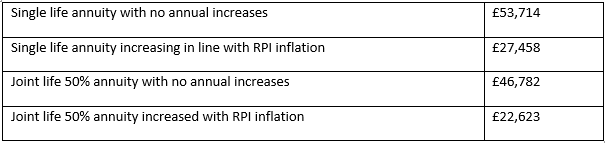
How you access your pension can also have a significant impact. According to research from Fidelity, a £1 million income used to purchase an annuity could provide an income from £22,623 to £53,714 for a healthy man aged over 65. That’s a huge difference that demonstrates why it’s important to consider your options and what’s important to you.

An annuity is something you buy that will then deliver a regular income for the rest of your life. It can help create financial certainty in retirement. When purchasing an annuity, you will have to make several decisions, including if you want the annuity to provide an income for your partner if you pass away, and whether you want it to increase in line with inflation to maintain your spending power. The below table highlights how the decisions you make with a £1 million pension can affect your income.

Source: Fidelity

The table is based on a male aged over 65 in good health and, for the joint life policies, a female dependent aged over 62 in good health. It’s important to note that annuity rates cannot be guaranteed. The rate offered will depend on your age, lifestyle and health, as well as the wider market. 

An annuity isn’t the only way to access your pension, however. You may also choose to use flexi-access drawdown. This is where you can flexibly withdraw money from your pension while the rest will usually remain invested.

While you’d be in control of how much income you take, you need to consider what’s sustainable. Withdrawing too much too soon could mean you run out during your lifetime.

As a rule of thumb, you shouldn’t withdraw more than 4% each year for withdrawals to be sustainable. For a £1 million pension that would mean an annual income of £40,000.

However, while this rule can give you a general idea, it’s important to look at your own finances. Longer retirements can mean the 4% rule no longer makes sense and a lower withdrawal rate is appropriate. Investment performance could also affect the value of your pension. When using drawdown, you need to consider your circumstances now and how they could change over your retirement to ensure you’re financially secure.

Using cashflow modelling to understand your pension

While a £1 million pension can certainly provide security in retirement, it may not mean the lavish lifestyle that first springs to mind. It’s still important that you consider how to make use of your pension so that it provides an income for the rest of your life.

Whether you have £1 million in your pension or not, we can help you understand what level of income you can expect throughout retirement, as well as planning for unexpected costs you may face. We’re here to help you pull together other sources of income you may have too, such as investments, property, or savings.

We know that it can be difficult to visualise how your wealth and income could change over a retirement that may last decades. Cashflow modelling can provide you with a way to visualise how the decisions you make at retirement, and even before, can affect the rest of your life. It’s a process that can let you explore the different options and mean you have confidence in the future.

Please contact us if you’d like to arrange a meeting to discuss your retirement income and the lifestyle it can offer.

Please note: This blog is for general information only and does not constitute advice. The information is aimed at retail clients only.

A pension is a long-term investment not normally accessible until 55 (57 from April 2028). The fund value may fluctuate and can go down, which would have an impact on the level of pension benefits available. Past performance is not a reliable indicator of future results.

The tax implications of pension withdrawals will be based on your individual circumstances. Thresholds, percentage rates and tax legislation may change in subsequent Finance Acts. 

Written by SteveB · Categorized: News

  • « Previous Page
  • 1
  • …
  • 54
  • 55
  • 56
  • 57
  • 58
  • …
  • 87
  • Next Page »
Ashworth Financial Planning Ltd is authorised and regulated by the Financial Conduct Authority. You can find Ashworth Financial Planning Ltd on the FCA register by clicking here. Registered in England & Wales. Company number: 08401597. Registered Office: Unit 1-1A, Park Lane Business Centre Park Lane, Langham, Colchester, Essex, England, CO4 5WR.

© 2026 · Ashworth FP · Legal · Web Design by D*Haus Agency