ASHWORTH

Financial Planning

  • Home
  • About Us
    • Stephen Buckle
    • Rachel Buckle
    • Wendy Bloomfield
    • Becky Evans
  • About You
    • People planning for retirement
    • People who have already retired
    • Business owners
  • What We Do
    • Financial Planning
    • How We Work
    • Investment Management
    • Solicitors & Accountants
  • Why choose us?
    • Our charity partners
  • Case studies
  • News
  • Contact
  • Client Portal

Sep 10 2025

5 challenges a financial midlife MOT could help you overcome

Your midlife can be an exciting time; you may have ticked off some goals or bucket list items and are looking forward to what the future holds. Yet, it might also present some new challenges. Arranging a financial midlife MOT could help you overcome obstacles and feel confident as you prepare for the next chapter. 

While you might have a better understanding of what you want to get out of life than when you were younger, finances can often become more complex, making it difficult to understand what’s possible. A financial midlife MOT gives you a chance to examine your finances now and calculate if you’re on track to reach your aspirations.

Here are five common challenges a financial MOT could help you navigate.

1. Merging your finances with a partner

    As you start to consider retirement and your future, you may opt to merge finances with your partner if you don’t already.

    Bringing together your finances can be challenging at any time, but particularly when you’re older, as you may both already hold assets, such as pensions or property. Working with a financial planner could help you take stock of your assets and start to understand how they might form part of your financial plan as a couple.

    As well as juggling two sets of assets, you might have different views on financial priorities and long-term goals.

    As your financial plan places your aspirations at the centre, a midlife MOT could help you clarify your priorities and balance them with your partner’s.

    2. Planning for your retirement

    66% of people aged between 45 and 49 feel unprepared for retirement, according to research from LV published in June 2025.

    Retirement might feel years away, but it’s a milestone that benefits from early preparation. The decisions you make now could affect your income in your later years, so weighing up your options is essential.

    A financial midlife MOT can include reviewing your pensions and other assets you intend to use in retirement to calculate if you have “enough” to live the retirement lifestyle you’re looking forward to.

    You could find you’re already on track and enjoy peace of mind as a result. If you discover there’s a potential shortfall, knowing this sooner puts you in a stronger position to bridge the gap, and a financial plan highlights the steps you might take.

    3. Balancing care responsibilities

    While you might no longer have young children to care for, you could find that you still have care responsibilities during your midlife.

    In fact, according to December 2024 research from Legal & General, 1 in 6 middle-aged people support other adults financially, such as grown-up children or elderly parents.

    If this isn’t something you’ve considered as part of your financial plan, it could make it harder to budget now and may affect your financial security in the future.

    It’s not just your finances that care duties may affect. 1 in 7 midlifers said they provide unpaid care, with hours equivalent to a part-time job. Around half said they feel overwhelmed by their weekly commitments. This can take a toll on your overall wellbeing.

    A financial plan that’s focused on what’s important to you could help you balance new responsibilities with your personal goals. For example, you might pay for a carer a few times a week so you’re still able to attend social clubs that you enjoy.

    4. Improving your financial resilience

    While you might have ticked off some financial commitments, such as paying your mortgage or children’s school fees, it’s still important to ensure you could withstand a financial shock. Your income stopping or facing an unexpected bill often has the potential to derail your plans.

    A midlife review gives you the opportunity to evaluate your financial security and assess how you’d cope with an unexpected event.

    You might check if you hold enough cash in your emergency fund or review your financial protection to see if you have an adequate safety net. While you hope never to need it, a financial safety net can provide reassurance and protection if the unexpected happens.

    5. Setting out your legacy

    It’s easy to think that you don’t need to consider how you’ll pass on assets to your loved ones yet. However, it’s impossible to know what’s around the corner, and there may be benefits to passing on wealth during your lifetime rather than waiting to leave an inheritance.

    Putting together an estate plan can be difficult. Not only are you bringing together all your assets and considering how circumstances may change in the coming decades, it’s also an emotional topic. So, if it’s something you’ve been putting off, you’re not alone.

    It may be daunting at first, but your estate plan allows you to take control of your legacy. As your financial planner, we can help you create an estate plan that gives you long-term security while supporting the people who are important to you.

    Contact us to arrange a financial midlife MOT

    Get the most out of your life by feeling confident about your finances. Please contact us to talk to one of our team members and arrange a financial review.

    Please note: This blog is for general information only and does not constitute financial advice, which should be based on your individual circumstances. The information is aimed at retail clients only.

    The value of your investments (and any income from them) can go down as well as up, and you may not get back the full amount you invested. Past performance is not a reliable indicator of future performance.

    Investments should be considered over the longer term and should fit in with your overall attitude to risk and financial circumstances.

    A pension is a long-term investment not normally accessible until 55 (57 from April 2028). The fund value may fluctuate and can go down, which would have an impact on the level of pension benefits available. Past performance is not a reliable indicator of future performance.

    The tax implications of pension withdrawals will be based on your individual circumstances. Thresholds, percentage rates, and tax legislation may change in subsequent Finance Acts. 

    Note that life insurance and financial protection plans typically have no cash in value at any time, and cover will cease at the end of the term. If premiums stop, then cover will lapse.

    Cover is subject to terms and conditions and may have exclusions. Definitions of illnesses vary from product provider and will be explained within the policy documentation.

    The Financial Conduct Authority does not regulate estate planning.
    Written by SteveB · Categorized: News

    Sep 10 2025

    Your future self is a stranger, and it could affect your financial decisions

    This guest blog was written by Chris Budd, who wrote the original Financial Wellbeing Book as well as The Four Cornerstones of Financial Wellbeing. He founded the Institute for Financial Wellbeing and has written more than 100 episodes of the Financial Wellbeing Podcast.

    There is a dilemma at the heart of financial planning that explains why we so often fail to take the steps now which will benefit ourselves in the future. Connecting with our future selves is one of the keys to successful planning.

    How your brain works

    While studying the brain, neuroscientists discovered that we use one part of the brain when thinking about ourselves, and a different part when we think about other people1. They wired up the brain and observed that different parts of the brain light up when we think of someone else now to when we think about ourselves now.

    They then found something remarkable. When we think of ourselves in the future, the part of the brain that lights up is the part that thinks of other people. When we think about our future self, we treat them as if they were a stranger to us.

    This is one reason why so many of us find it hard to save and to plan for the future; to put money, into a pension fund, for example, feels like we are giving our money away to someone else.

    3 ways to connect

    To envisage our future selves, we need to be able to make a connection. This must happen on three levels:

    1. Physical
    2. Emotional
    3. A clear path

    Only when we make a real connection with our future are we likely to treat our future self less like a stranger. This can then have an impact on whether we take action now.

    Physical connection

    In order to make a connection at a physical level, we need to be able to see our future selves. There are several ways of achieving this. One could be the use of an ageing app. If you see a picture of yourself at the age at which you are planning for, perhaps by using an aged picture of yourself on the front of a financial plan, this is going to create a physical connection. However, this might not work for everyone – not all of us are comfortable seeing ourselves aged.

    Maybe your future objectives involve something physical. For example, moving to live by the sea. Using images of the future can help create a firm connection. Put a picture of the seaside on your fridge, for instance.

    This tip does need a caveat: it’s not always good to create inflexible plans. Things change, and one should try to choose images that create a general direction, rather than a fixed destination. In the example given, it might be a modest and generic place by the sea, rather than an expensive house in a favourite location.

    We are trying to create a connection to a desirable and achievable future, not dream of big things to inspire us to work harder.

    Emotional connection

    We are more likely to feel connected to our future self when that self is based upon our own assumptions and desires. One piece of research found that people who strongly identify with their future selves are six times more likely to contribute significant amounts to their pensions. They also enjoy their work more and find it more meaningful2.

    One strong motivator is having meaning and purpose. What will make you feel proud in the future? Take some time to envisage what a day in the future might look like. From waking up and making breakfast to heading out for the day. What do these look like? Where are you? Who are you with?

    A clear path

    One of the five key pillars of financial wellbeing for the Institute for Financial Wellbeing (IFW) is having a clear path to identifiable objectives.

    If we were to insert “your future self” in place of identifiable objectives, then we can see that the next important part of the process is to create a series of steps to go in that general direction. This will help test whether that future self is realistic. Your financial plan can test different scenarios to see which might be possible and which are perhaps a little unrealistic.

    Conclusion

    Our inability to picture our future selves has been an unconscious inhibitor for financial planning over the years. Now that we know the challenge in front of us, we can create a better image of our future and create a clear path towards it.

    1Your Future Self by Hal Hershfield

    2From Aegon’s Centre for Behavioural Research, as recounted in Your Path to Prosperity by Thomas Mathar

    Please note: This blog is for general information only and does not constitute financial advice, which should be based on your individual circumstances. The information is aimed at retail clients only.

    Written by SteveB · Categorized: News

    Sep 10 2025

    Investment market update: August 2025

    While global government policy – particularly US trade tariffs – continued to influence the value of investments in August 2025, many markets experienced less volatility compared to the start of the year. Read on to discover what factors may have affected the performance of your investments in August 2025.

    Hopes of a peace deal between Russia and Ukraine boost markets

    On 31 July, Donald Trump, the US president, signed an executive order imposing reciprocal tariffs of up to 41% on certain trading partners. The effect of this influenced market movements at the start of August.

    On 1 August, Asian stock market indices, which track the performance of a selected group of stocks, fell. South Korea’s KOSPI was down 3%, while Japan’s Nikkei decreased by 0.4%.

    The uncertainty also affected European and US markets. Even though the UK has a trade deal with the US, the FTSE 100 was down 0.5%, while the Dow Jones (-1.1%) and S&P 500 (-1.2%) both fell when Wall Street opened in the US.

    There was good news for investors in the UK market on 6 August. The FTSE 100 reached a new closing high after it increased by 0.24%. Among the biggest risers were insurer Hiscox (9.4%), precious metal producer Fresnillo (8.9%), and drinks company Diageo (4.2%).

    Ahead of US-Russia talks about the war in Ukraine, European stocks cautiously increased on 11 August. The FTSE 100 was up 0.3%, Germany’s DAX and France’s CAC both edged up almost 0.2%, and Italy’s FTSE MIB increased by 0.45%.

    The MSCI’s broad All Country World Index, which tracks stocks from 23 developed and 24 emerging markets, hit an all-time high on 13 August. One of the driving factors was the hope that the US will cut its base interest rate in September.

    Further speculation that Russia and Ukraine would strike a peace deal fuelled European stock markets on 19 August. Europe’s Stoxx 600 index increased by 0.6%.

    In the first half of 2025, European defence companies saw stocks increase due to rising tensions. With investors hoping for de-escalation, defence stocks, including BAE Systems (-3.6%), Rheinmetall (-4.2%), and Thales (-3.5%), fell.

    Despite official data showing inflation was higher than expected in the UK, the FTSE 100 hit another record high on 20 August following a jump of 0.67%.

    UK

    Inflation in the UK continued to rise in the 12 months to July 2025. Official data shows it was 3.8% and the highest annual reading since early 2024.

    Despite persistent high inflation, the Bank of England opted to cut the base interest rate by a quarter of a percentage point to 4%. However, the central bank noted that inflation could slow the pace of further cuts.

    Overall business activity is improving, according to a Purchasing Managers’ Index (PMI), which provides insight into economic conditions.

    S&P Global’s August PMI recorded the strongest rise in UK business activity in the year to date, with a reading of 53 (a figure above 50 indicates growth) compared to 51.5 in July.

    However, PMI data wasn’t as positive for the construction sector. In July, the reading was 44.3, suggesting contraction at the fastest pace in five years. Builders reported a decline in housing projects, which could suggest the government is struggling to hit housebuilding targets.

    A report from the British Chambers of Commerce demonstrates the effects of trade tariffs. Goods exported to the US slumped by 13.5% in the second quarter of 2025. The figure is the lowest level in three years, when the Covid-19 pandemic severely disrupted trade.

    There was some good news for investors from British fossil fuel giant BP.

    BP revealed the largest oil and gas discovery in 25 years off the coast of Brazil. The news was followed by a statement from the company, which said, subject to board approval, it would raise quarterly dividends by at least 4%. 

    Europe

    Eurozone inflation remained stable at 2%, though it varied significantly across the bloc from Cyprus at 0.1% to Romania at 6.6%.

    PMI figures from Hamburg Commercial Bank paint an optimistic picture for the EU economy.

    As the largest economies in the EU, the performance of companies in Germany and France is important, and both strengthened in August. Germany’s PMI improved for the third consecutive month with a reading of 50.9. While France is just below the 50 mark, which indicates growth, with a reading of 49.8, it’s the highest figure so far in 2025.

    Across the eurozone, PMI data shows the manufacturing sector increased production at the fastest pace in more than three years. The reading suggests businesses may be feeling more optimistic as uncertainty around trade tariffs settles.

    US

    Economists predicted that US inflation would increase, but it remained stable at 2.7% in the 12 months to July.

    Weakening demand for US exports due to tariffs has been linked to manufacturing slowing and the trade deficit narrowing.

    A PMI conducted by the Institute of Supply Management shows new orders fell in July. Some companies blamed the disruption and confusion caused by changing trade policy.

    In addition, the US trade deficit narrowed as companies rushed to import goods into the US before tariffs were applied. The gap between exports and imports was $60.2 billion (£44.5 billion) in June 2025 after a decline of $11.5 billion (£8.5 billion) when compared to May 2025.

    There was some good news in the form of PMI data. According to S&P Global, US business activity hit an eight-month high.

    US company OpenAI, the group behind ChatGPT, is in talks about a share sale that would value the company at $500 billion (£370 billion). The company isn’t listed on the stock market, and the talks are focusing on a potential sale for current and former employees, who could potentially make large returns by selling the shares on the secondary market.

    Asia

    China’s exports increased by 7.2% year-on-year in July 2025. The figure was higher than expected and is due to manufacturers taking advantage of a trade war truce between China and the US.

    However, while exports increased in July, the ongoing trade war is harming China’s economy. Chinese industrial output increased by 5.7% in July, the slowest rate since November 2024 and below the 6% expected.

    The largest automaker in the world, Japanese company Toyota, warned it would take a $9.5 billion (£7 billion) hit from Trump’s tariffs. As a result, it has cut its operating profits for the current financial year from £19.2 billion to £16 billion.

    Please note: This blog is for general information only and does not constitute financial advice, which should be based on your individual circumstances. The information is aimed at retail clients only.

    The value of your investments (and any income from them) can go down as well as up, and you may not get back the full amount you invested. Past performance is not a reliable indicator of future performance.

    Investments should be considered over the longer term and should fit in with your overall attitude to risk and financial circumstances.

    Written by SteveB · Categorized: News

    Aug 01 2025

    Explained: Why overpaying your mortgage could save you thousands of pounds

    Overpaying your mortgage could mean you’re mortgage-free sooner, but did you also know it could save you thousands of pounds in interest?

    If you have a direct debit set up, it’s easy to think of your mortgage as a set cost that you can’t change. However, it’s often possible to make overpayments regularly or as a one-off lump sum. Even seemingly small amounts could really make a difference when you work out the total cost of borrowing.

    Overpayments reduce outstanding mortgage debt

    If you have a repayment mortgage, your regular mortgage payment will cover the accrued interest and a portion of the outstanding balance. In contrast, when you make an overpayment, all of it goes towards reducing your mortgage debt.

    As interest is calculated based on the outstanding balance, after you’ve made an overpayment, the amount of interest added the following month is lower. Over a long-term time frame, even small overpayments can compound and save you a significant amount. 

    The power of regular mortgage overpayments

    Imagine you have a £300,000 repayment mortgage with a 25-year term and an interest rate of 4.5%.

    Your regular repayments would be £1,167, and over the full mortgage term, the total interest paid would add up to £200,053.

    However, if you decide to overpay your mortgage by £100 each month, the total interest paid would fall to £177,690 and you’d pay off your mortgage two years and five months early. So, you’d save more than £22,000.

    A one-off mortgage overpayment could save you money too

    You might also choose to put the money for overpayments to one side and pay it as a lump sum. This could be useful if you might need the money to cover your day-to-day outgoings or you want it to be accessible in the short term in case of an unexpected expense.

    Using the above scenario of a 25-year £300,000 repayment mortgage with an interest rate of 4.5%, if you made a one-off overpayment of £20,000 at the start of your mortgage, you’d reduce your mortgage term by two years and 10 months, and save £37,440 in interest.

    Balancing your short- and long-term finances

    So, as the figures show, overpaying will mean your outgoings will rise now, but you’ll benefit from paying less in the long term.

    Whether it’s the right decision for you will depend on your financial circumstances and priorities. Taking some time to understand your short- and long-term goals could help you assess how overpayments could fit into your budget now or in the future.

    One benefit of choosing to overpay, rather than shortening your mortgage term, is that it’s flexible. So, if your financial circumstances change or an unexpected bill arrives, you’re able to stop the overpayments to reflect this.

    Check if you could pay an early repayment charge when making overpayments 

    If you have a mortgage deal in place, you may face an early repayment charge (ERC) if you make overpayments, so be sure to check your paperwork first.

    Usually, you can reduce the total outstanding balance by 10% a year through overpayments without incurring an ERC. However, this differs between providers. An ERC is typically a percentage of the debt you’ve repaid, so it could be a significant bill if you’ve paid a lump sum.

    If you don’t have a mortgage deal, you can normally make overpayments without an ERC being applied. While this may be a benefit of not having a mortgage deal, usually the interest rate you pay isn’t competitive. Your mortgage adviser could help you assess your needs and understand if finding a deal could make financial sense for you.

    Contact us to talk about your mortgage needs

    If you’re searching for a new mortgage and would like the flexibility to make overpayments, please contact us. We could help you save money and reach the mortgage-free milestone sooner.

    Please note: This blog is for general information only and does not constitute financial advice, which should be based on your individual circumstances. The information is aimed at retail clients only.

    Your home may be repossessed if you do not keep up repayments on a mortgage or other loans secured on it.

    Written by SteveB · Categorized: News

    Aug 01 2025

    Think cash is king? It might be time to review your mantra

    Cash can be comforting. It’s familiar, it’s accessible, and it’s tangible. But while cash savings can be part of a well-balanced financial plan, they’re not always the best-performing asset.

    Data shows that many UK adults are reluctant to depart from cash. In an update reported by MoneyWeek, the Financial Conduct Authority (FCA) reported that 61% of adults with £10,000 or more in investible assets are holding at least three-quarters in cash. 1 in 5 adults have cash savings of £25,000 or more, and around 1 in 10 have savings exceeding £50,000.

    The regulator warned that holding such a large proportion of assets in cash could mean UK adults are missing out on the longer-term returns potentially available from investing, even when savings interest rates are high.

    Read on to find out alternative options to cash, how to begin moving into other investments, and the times cash might be a more appropriate choice.

    Global economic uncertainty saw more investors turning to cash, but history tells us markets do rally

    Part of the appeal of cash currently can be attributed to market volatility that spooked investors in the early months of 2025, with President Trump’s tariff announcements causing widespread uncertainty.

    According to a May 2025 report from MoneyAge, this caused a rise in the number of DIY investors – those who manage their own portfolio – turning to cash. Between February and April, 56% increased their exposure to cash, a 10% increase compared to investors who switched to cash after the 2024 Autumn Budget.

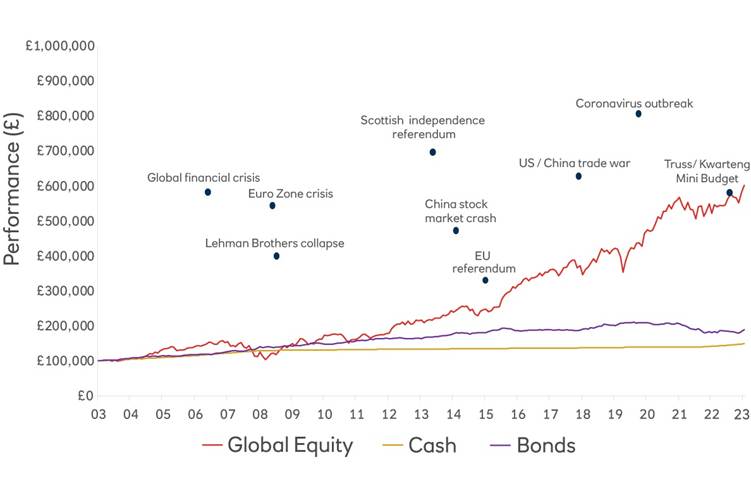
    It’s understandable for you to want your wealth kept safe, and for global turbulence to drive you to think about cashing in. But history tells us that volatility is to be expected. While we can’t rely on past performance as an indicator for the future, we can also see that markets bounced back quickly from events such as the 2008 financial crisis, the pandemic, and the beginning of the conflict in Ukraine.

    The below graph from NatWest covering the period between 2003 and 2023 highlights this, showing the return on global equities (shares), bonds, and cash at critical points in history. Although cash remains relatively level, the eventual returns from bonds and equities would have been higher.

    Rising inflation could have a negative effect on your purchasing power

    Inflation is always another key consideration with cash savings. Unless your savings interest rate is consistently above the rate of inflation, the real value of your money could remain the same, or even go down.

    Ultimately, this could dent your purchasing power in the long term.

    Consider this example. You have £100, which can buy £100 of goods and services today. If you save your money in a bank account with 1% interest, you’ll have £101 next year. But if inflation is 5%, those same goods and services will cost £105 next year. With £101, the money in the bank would no longer be enough to buy it – it has lost value in real terms.

    Historically, shares and bonds have always outperformed cash. According to Vanguard, data from 1901 to 2024 shows that average annual returns after inflation were:

    • 5.34% for global shares
    • 1.36% for bonds
    • 0.89% for cash.

    So, you can see the argument for investing at least some of your wealth, helping it keep pace with the rising cost of living.

    Considering your goals and risk approach can help design a suitable investment portfolio for you

    Shifting some of your cash savings into investments could help you see better returns. But before you do this, the first thing to consider is your goals. For example, are you hoping to receive an income from your investments, or are you investing for long-term growth?

    This can help you determine the right place for your wealth. You also need to consider your approach to risk: do you want a low-risk option that will pay out less, or a higher-risk alternative with potentially higher returns?

    Talking with a financial planner can help you establish your own financial strategy, based on your aspirations, risk tolerance, and preferences. They can work with you to build a diverse portfolio, meaning that if you see losses in one area, these could be mitigated in others.

    Some of the most common types of investments you could consider include:

    • Stocks and shares. These are a stake in a company, and are traded on a stock exchange. The price of shares can go up or down.
    • Bonds. Investing in a bond means you’re effectively lending money to a company or government, which they pay back at a fixed rate of interest. They’re a more stable investment than shares, but can be negatively impacted by interest rate fluctuations.
    • Funds. Here, your money is invested along with other people’s to buy a range of assets, which can include shares and bonds, helping to diversify your investments. As they’re also spread across different markets and sectors, poor performance in one area can be offset by others.

    There are other investment options, too, which a financial planner can talk through with you.

    Cash is a good option for short-term goals and as an emergency fund

    None of this is to say that cash is obsolete. Far from it, cash can be an important part of a well-balanced financial plan.

    It’s a good idea to have a cash reserve in place as an “emergency fund”, which could be three to six months’ worth of your essential outgoings.

    It can also make sense to save for short-term goals and purchases in cash savings. For example, if you’re saving for a holiday in a year’s time, you need to know that you’ve saved enough, without risk, and that it will be accessible when you need it.

    Get in touch

    Talk to us about how to strike the right asset balance, including cash, for your wealth portfolio.

    Please note:

    This blog is for general information only and does not constitute financial advice, which should be based on your individual circumstances. The information is aimed at retail clients only.

    The value of your investments (and any income from them) can go down as well as up and you may not get back the full amount you invested. Past performance is not a reliable indicator of future performance. 

    Investments should be considered over the longer term and should fit in with your overall attitude to risk and financial circumstances.

    Written by SteveB · Categorized: News

    Aug 01 2025

    The psychological influences that could affect your relationship with money

    Your relationship with money is related to far more than how much cash you have. In fact, psychological influences could be having more effect on your decisions and how you feel about wealth than you think.

    Speaking to the Guardian in July 2025, financial psychotherapist Vicky Reynal stated she believes thoughts and feelings about money have “everything to do with our earliest experiences, deepest yearnings, and misgivings”.

    Her unusual role sees Reynal work with clients to assess why they’re making certain financial decisions. She notes that while many clients understand what they need to do to improve their financial position at a rational level, they can’t bring themselves to do it.

    For example, some people know they need to cut back to balance their budget, but still obsessively purchase non-essential items like shoes. Or, on the other end of the spectrum, one client has ample means to purchase nice things but will only buy the basics.

    Taking a step back to understand why you make certain decisions could help improve your relationship with money and your chances of reaching long-term goals. Read on to discover some of the psychological influences that might affect you.

    Recognising these psychological influences could improve your relationship with wealth

    Previous experiences

    Past experiences have a profound effect on how you view current situations, and lessons from your childhood can be particularly influential. 

    If your family had a mindset that money is meant to be spent, you might find it difficult to save or invest for the future, even though you know it would benefit you in the long run. Alternatively, if you were encouraged to save all your money as a child, you may be reluctant to spend money on luxuries even if they’re affordable for you.

    A financial plan is centred on your goals and identifies the steps you need to take to turn them into a reality. So, by working with a professional, you could overcome the influence that past experiences might have.

    Money beliefs

    “Money beliefs” refers to deeply held and unconscious ideas you have about money. Again, these often start to form in childhood, and it can be difficult to spot when they’re influencing your decisions.

    For example, Reynal notes that if you grew up in a culture that thought of wealth as “immoral”, it can lead to a dilemma around what it means for you to become wealthy. For some, this money belief could mean they sabotage their financial security or build up wealth they worry about using for fear of judgment.

    Working with a financial planner could provide an opportunity to re-examine your money beliefs and why you’re making certain decisions.

    Comparing what you have to others

    As the common saying goes, comparison is the thief of joy.

    Sometimes, looking at what other people have can negatively affect your relationship with money. Such behaviour could then affect both your small and large financial decisions.

    You might feel envious when a family member shows off their latest gadget. But if you let emotions get the better of you, it could lead to you splurging on the item even though you didn’t want it before. Or you may be looking forward to your retirement at 65, but feel less enthusiastic once you discover a friend plans to give up work earlier.

    While it can be difficult at times, try to focus on your financial plan and stop making comparisons. Everyone’s path is different, and usually, you only see a snapshot of someone else’s life.

    Get in touch to talk about improving your relationship with money

    Setting clear goals and having a financial plan that reflects your circumstances could have a positive effect on your relationship with money. Please get in touch to discuss how you might turn your goals into a reality and feel more confident about your financial future.

    Please note: This blog is for general information only and does not constitute financial advice, which should be based on your individual circumstances. The information is aimed at retail clients only.

    Written by SteveB · Categorized: News

    • « Previous Page
    • 1
    • …
    • 7
    • 8
    • 9
    • 10
    • 11
    • …
    • 84
    • Next Page »
    Ashworth Financial Planning Ltd is authorised and regulated by the Financial Conduct Authority. You can find Ashworth Financial Planning Ltd on the FCA register by clicking here. Registered in England & Wales. Company number: 08401597. Registered Office: Unit 1-1A, Park Lane Business Centre Park Lane, Langham, Colchester, Essex, England, CO4 5WR.

    © 2026 · Ashworth FP · Legal · Web Design by D*Haus Agency